2006 ARRL 10 GHz and Up Contest
09/28/2006 |
VE3FN/2
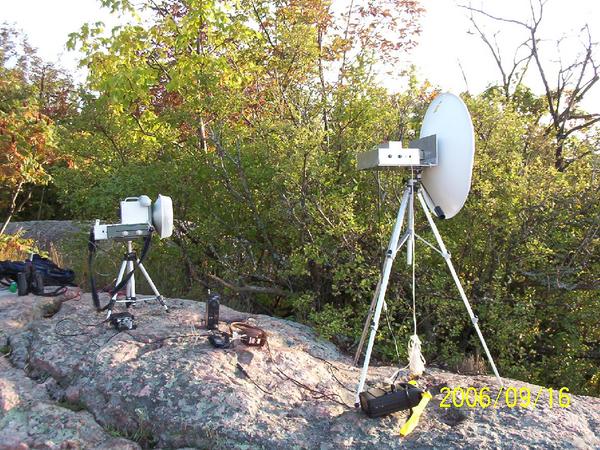
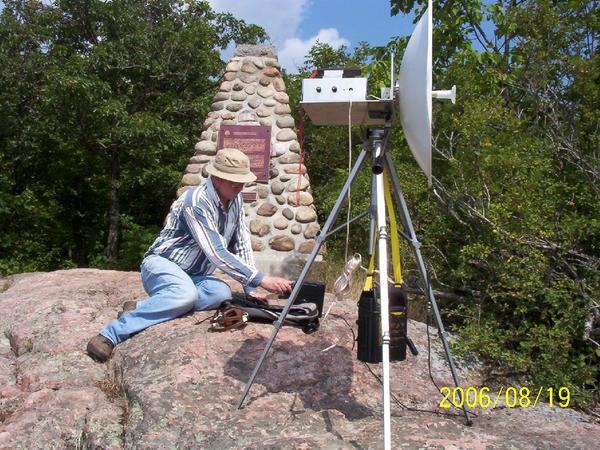
This year, most of our operating as VE3FN/2 was from the King Mountain trail (FN25bl) located in the Gatineau Park, Quebec, just northwest of Ottawa, Ontario. This site is at about 1150 feet ASL and 800 feet above the surrounding terrain. Accessing it requires a good hike over a rugged trail. In past years we have also operated from a nearby site in the Park (FN25bm) that is accessible by car. But it has more limited coverage -- shots to the southeast and east are blocked whereas they are available from the site on the trail.
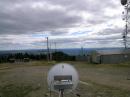
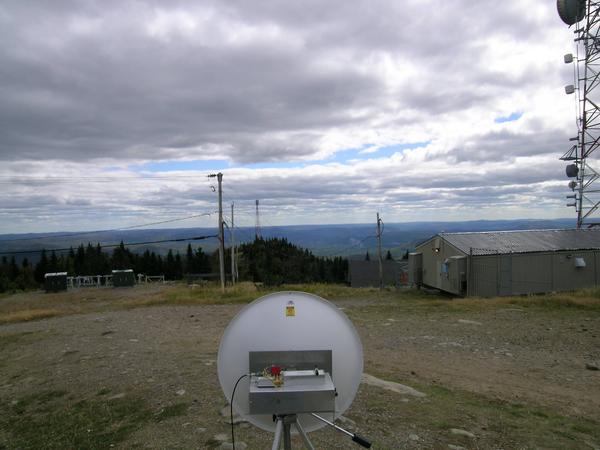
On Sunday of the second weekend, we activated Mont Tremblant, Quebec in FN26rf 2880 feet ASL.
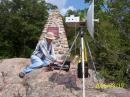
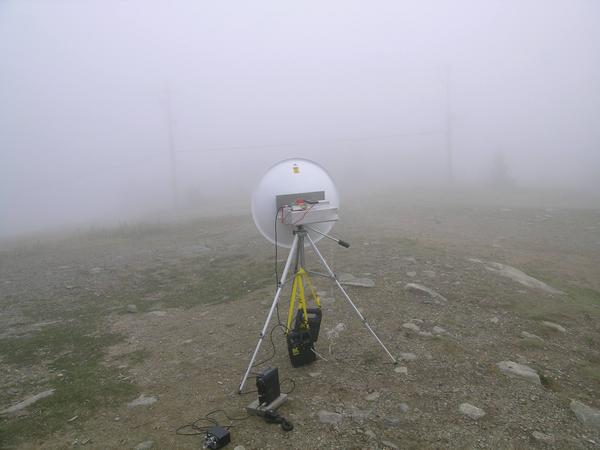
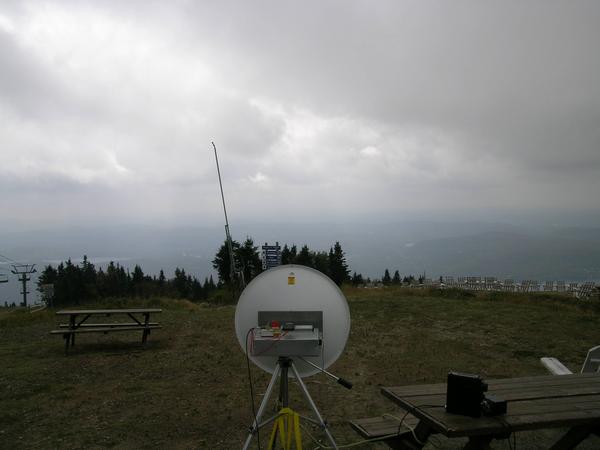
My station on 10 GHz consists of a DB6NT transverter driving a 2-Watt DB6NT amplifier. The antenna is a 2 foot dish.
On Saturday of the first weekend, Dave VO1AU/VE3AAQ, Doug VE3XK and I met at 7:00 at the parking lot for the King Mountain trail. As we had to carry everything, our station was limited. Large batteries were too heavy, so we had to limit ourselves to 20 Watts on the 2-meter liaison station.
We were set up just after 8:00 and immediately heard AF1T on Block Island, RI on 2 meters. But signals on 144 were not good and we did not make a QSO on 10 GHz almost 600 km! We then contacted VE3SMA (and others) in southwestern Ontario on 2 meters, but we failed to make a QSO on 10 GHz. Next we heard K2DU on a hill on the south shore of Lake Ontario, west of Rochester (FN02xu). We finally made our first contact by working him with good signals over a path of 339 km. We then worked W2DYY and AA2WV at the same site.
A while later, we heard W1AIM on Mount Equinox (FN33kd) on 2 meters and worked him easily on 10 GHz CW. We continued talking on SSB while waiting for W1GHZ to get set up for another successful QSO on 10 GHz. During my QSO with W1GHZ, I heard some SSB QRM the first I have experienced on 10 GHz. I eventually discovered that the QRM was from KT1J on Mansfield trying to get our attention, 26 degrees off the side of our dish. When I peaked the antenna on him, he pinned the S meter over the 263 km path! So that was my first 10 GHZ QSO made without first making a sked.
We ran out of battery capacity around noon and shut down. As it rained the next day, we did not operate. We ended the first weekend with 6 QSOs, all over paths of good lengths -- only one of these was less than 300 km.
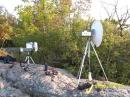
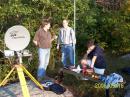
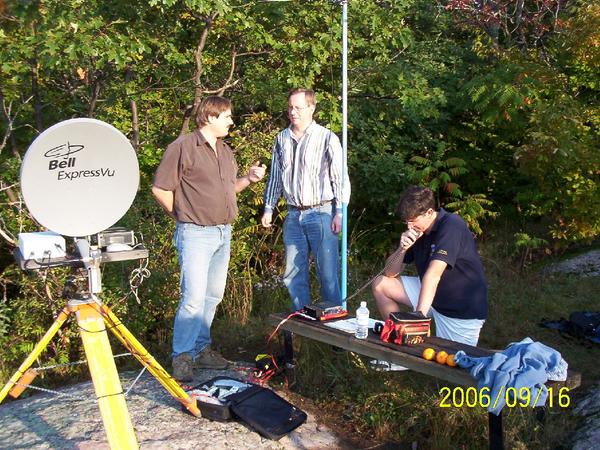
On Saturday of the second weekend, Dave VO1AU/VE3AAQ, Doug VE3XK and I again met at the parking lot for the King Mountain trail in the Gatineau Park. Steve, VE3TFU, also joined us. In addition to my narrowband gear, Doug brought his stripped down Tellurometer to try some wideband contacts. As we were carrying all we could, Steve had to carry his own 10 GHz equipment. We both used my 2-meter liaison station and he shared one of my small batteries for his 10 GHz station.
We were set up by 8:00. It was warm and sunny. But there was lots of fog below us and it rose up almost to our elevation before dissipating late in the morning. It was great to have Steve's equipment to verify that my station was working and to provide another set of ears.
Our first try was with W1GHZ on Block Island, RI, but no go. We tried a few more long-haul QSOs without success. We heard a couple of stations on Mount Washington, NH on 2 meters, but couldn't get their attention. Our first completed QSO of the day was just after 10:00 when we worked VE3NPB operating from FN04ra -- about 266 km. We then worked Jimmy VE2JWH with a good signal from Mount Shefford, QC (FN35qi) at 254 km followed shortly by Steve VE3SMA in FN03ux -- 249 km.
Doug tried a local QSO to Ottawa with the Tellurometer. The low fog made it difficult to pick out landmarks so he could aim the antenna. Ultimately there was no QSO because of equipment problems. Rick VE3CVG had driven to Rigaud Mountain, QC to try to work us with his Tellurometer. But he had difficulty accessing the summit and I don't think he ever found a location having a clear shot in our direction.
Dave VO1AU/VE3AAQ was operating the liaison station and he raised K1LPS on Mount Washington. We completed with him on 10 GHz over 385 km with very good signals. Henry KT1J was also on Mount Washington and he tail-ended K1LPS on SSB S9! Our final QSO on Saturday was with K2AXX operating from across Lake Ontario in FN02xu (339 km). We tore down about noon -- the batteries were pretty well dead anyway. So, our combined total for both weekends from FN25bl was 12 QSOs in 7 grids.
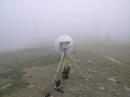
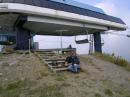
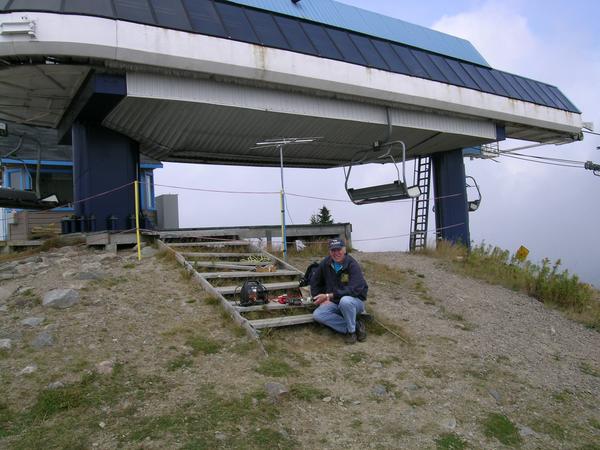
On Sunday morning, Doug VE3XK and I drove to Mont Tremblant (FN26rf). When we arrived, we could see that the peak was shrouded in fog. We got on the gondola when it started running at 9:30 and started setting up at the summit just before 10:00. The fog was so thick you could barely see buildings that were roughly 70 meters (200 feet) away. It's a good thing I had visited the site the previous weekend and knew where to set up. That previous weekend, I had tried unsuccessfully to work KT1J on 10 GHz when he was on Gore Mountain, NY.
It was chilly and there was a strong wind -- amazing what climbing 2,000 feet does! Doug used 2 batteries (about 7 pounds each) to weigh down the light microwave tripod. He also set one leg against the direction of the wind to provide more bracing. Later, he tied a rope guy to a rock. Condensation covered my glasses and got between the contacts of my paddle so the keyer wouldn't stop sending.
We immediately heard strong signals from Mount Washington on 2 meters, but we couldn't get through. We then heard Jimmy VE2JWH on 2 meters and he was again on Mount Shefford, QC (FN35qi). We easily worked on 10 GHz CW and SSB with signals that were S9 plus over the path of 183 km -- our first QSO from Tremblant! A short while later we heard KT1J (on 2 meters) who was now on Whiteface (FN34bi -- 217 km) -- again, S9 plus on 10 GHz SSB. At a little after 11:00 we worked K1LPS who was again on Mount Washington (335 km) with S9 signals on SSB. Larry had to move to find a location with a shot in our direction.
As far as the contest was concerned, that was it. We called and called several stations who had strong signals from Mount Washington on 2 meters. A couple briefly acknowledged us, but said they would have to move to move to a spot with a shot in our direction. Both K1LPS and VE2JWH said folks knew we were in FN26 and that we would be popular. But there seemed to be little interest, probably because there is no incentive (in this contest) to work different grids.
From Mont Tremblant (FN26rf), we didn't hear any signals to the west or very far south. I think that this was partly because we were not set up until after the peak of propagation. Of course, we were farther away from that activity -- about 80 km north and 100 km east of our location in the Gatineau Park.
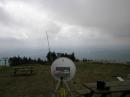
The fog gradually dissipated, but was still there when we shut down at 15:00. At least we could see the valleys (with some blockage by fog), but the horizon was still obscured. The wind remained strong the whole time. Just before shutting down, we tried a QSO with VE3NPB in FN04ra. But it was a long shot and we were well off the time of peak propagation. Anyway, nothing was heard.
I did find a small building (near our operating site) that had electrical power outlets on the outside wall. So on future visits, we will have a source of power for a 2 meter amplifier, thus improving our ability to be heard. It was frustrating to make only 3 QSOs (in 3 grids) in 5 hours -- especially when there were several others on Mount Washington we should have been able to work easily.
We ended the contest with a total of 15 QSOs from both locations over both weekends. The average path length of our QSOs was over 300 km.
73
Ray VE3FN -- VE3FN
On Sunday of the second weekend, we activated Mont Tremblant, Quebec in FN26rf 2880 feet ASL.
My station on 10 GHz consists of a DB6NT transverter driving a 2-Watt DB6NT amplifier. The antenna is a 2 foot dish.
On Saturday of the first weekend, Dave VO1AU/VE3AAQ, Doug VE3XK and I met at 7:00 at the parking lot for the King Mountain trail. As we had to carry everything, our station was limited. Large batteries were too heavy, so we had to limit ourselves to 20 Watts on the 2-meter liaison station.
We were set up just after 8:00 and immediately heard AF1T on Block Island, RI on 2 meters. But signals on 144 were not good and we did not make a QSO on 10 GHz almost 600 km! We then contacted VE3SMA (and others) in southwestern Ontario on 2 meters, but we failed to make a QSO on 10 GHz. Next we heard K2DU on a hill on the south shore of Lake Ontario, west of Rochester (FN02xu). We finally made our first contact by working him with good signals over a path of 339 km. We then worked W2DYY and AA2WV at the same site.
A while later, we heard W1AIM on Mount Equinox (FN33kd) on 2 meters and worked him easily on 10 GHz CW. We continued talking on SSB while waiting for W1GHZ to get set up for another successful QSO on 10 GHz. During my QSO with W1GHZ, I heard some SSB QRM the first I have experienced on 10 GHz. I eventually discovered that the QRM was from KT1J on Mansfield trying to get our attention, 26 degrees off the side of our dish. When I peaked the antenna on him, he pinned the S meter over the 263 km path! So that was my first 10 GHZ QSO made without first making a sked.
We ran out of battery capacity around noon and shut down. As it rained the next day, we did not operate. We ended the first weekend with 6 QSOs, all over paths of good lengths -- only one of these was less than 300 km.
On Saturday of the second weekend, Dave VO1AU/VE3AAQ, Doug VE3XK and I again met at the parking lot for the King Mountain trail in the Gatineau Park. Steve, VE3TFU, also joined us. In addition to my narrowband gear, Doug brought his stripped down Tellurometer to try some wideband contacts. As we were carrying all we could, Steve had to carry his own 10 GHz equipment. We both used my 2-meter liaison station and he shared one of my small batteries for his 10 GHz station.
We were set up by 8:00. It was warm and sunny. But there was lots of fog below us and it rose up almost to our elevation before dissipating late in the morning. It was great to have Steve's equipment to verify that my station was working and to provide another set of ears.
Our first try was with W1GHZ on Block Island, RI, but no go. We tried a few more long-haul QSOs without success. We heard a couple of stations on Mount Washington, NH on 2 meters, but couldn't get their attention. Our first completed QSO of the day was just after 10:00 when we worked VE3NPB operating from FN04ra -- about 266 km. We then worked Jimmy VE2JWH with a good signal from Mount Shefford, QC (FN35qi) at 254 km followed shortly by Steve VE3SMA in FN03ux -- 249 km.
Doug tried a local QSO to Ottawa with the Tellurometer. The low fog made it difficult to pick out landmarks so he could aim the antenna. Ultimately there was no QSO because of equipment problems. Rick VE3CVG had driven to Rigaud Mountain, QC to try to work us with his Tellurometer. But he had difficulty accessing the summit and I don't think he ever found a location having a clear shot in our direction.
Dave VO1AU/VE3AAQ was operating the liaison station and he raised K1LPS on Mount Washington. We completed with him on 10 GHz over 385 km with very good signals. Henry KT1J was also on Mount Washington and he tail-ended K1LPS on SSB S9! Our final QSO on Saturday was with K2AXX operating from across Lake Ontario in FN02xu (339 km). We tore down about noon -- the batteries were pretty well dead anyway. So, our combined total for both weekends from FN25bl was 12 QSOs in 7 grids.
On Sunday morning, Doug VE3XK and I drove to Mont Tremblant (FN26rf). When we arrived, we could see that the peak was shrouded in fog. We got on the gondola when it started running at 9:30 and started setting up at the summit just before 10:00. The fog was so thick you could barely see buildings that were roughly 70 meters (200 feet) away. It's a good thing I had visited the site the previous weekend and knew where to set up. That previous weekend, I had tried unsuccessfully to work KT1J on 10 GHz when he was on Gore Mountain, NY.
It was chilly and there was a strong wind -- amazing what climbing 2,000 feet does! Doug used 2 batteries (about 7 pounds each) to weigh down the light microwave tripod. He also set one leg against the direction of the wind to provide more bracing. Later, he tied a rope guy to a rock. Condensation covered my glasses and got between the contacts of my paddle so the keyer wouldn't stop sending.
We immediately heard strong signals from Mount Washington on 2 meters, but we couldn't get through. We then heard Jimmy VE2JWH on 2 meters and he was again on Mount Shefford, QC (FN35qi). We easily worked on 10 GHz CW and SSB with signals that were S9 plus over the path of 183 km -- our first QSO from Tremblant! A short while later we heard KT1J (on 2 meters) who was now on Whiteface (FN34bi -- 217 km) -- again, S9 plus on 10 GHz SSB. At a little after 11:00 we worked K1LPS who was again on Mount Washington (335 km) with S9 signals on SSB. Larry had to move to find a location with a shot in our direction.
As far as the contest was concerned, that was it. We called and called several stations who had strong signals from Mount Washington on 2 meters. A couple briefly acknowledged us, but said they would have to move to move to a spot with a shot in our direction. Both K1LPS and VE2JWH said folks knew we were in FN26 and that we would be popular. But there seemed to be little interest, probably because there is no incentive (in this contest) to work different grids.
From Mont Tremblant (FN26rf), we didn't hear any signals to the west or very far south. I think that this was partly because we were not set up until after the peak of propagation. Of course, we were farther away from that activity -- about 80 km north and 100 km east of our location in the Gatineau Park.
The fog gradually dissipated, but was still there when we shut down at 15:00. At least we could see the valleys (with some blockage by fog), but the horizon was still obscured. The wind remained strong the whole time. Just before shutting down, we tried a QSO with VE3NPB in FN04ra. But it was a long shot and we were well off the time of peak propagation. Anyway, nothing was heard.
I did find a small building (near our operating site) that had electrical power outlets on the outside wall. So on future visits, we will have a source of power for a 2 meter amplifier, thus improving our ability to be heard. It was frustrating to make only 3 QSOs (in 3 grids) in 5 hours -- especially when there were several others on Mount Washington we should have been able to work easily.
We ended the contest with a total of 15 QSOs from both locations over both weekends. The average path length of our QSOs was over 300 km.
73
Ray VE3FN -- VE3FN
Photo Gallery
-
 Modified Tellurom...
-
 VE3FN operating 1...
-
 VE3TFU with his s...
-
 Mont Tremblant lo...
-
 "Vista" on arriva...
-
 VE3XK operating 2...
-
 View to SW, after...
Back