2008 ARRL 10 GHz and Up Contest
08/22/2008 |
KA7OEI
Microwave activity can be sparse in Utah, but contests like this one give people an excuse to drag their gear out into the wilds.
While there wasn't exactly a pileup, there was about as much activity on 10 GHz this time as there ever has been: Bryan, W7CBM had enough time to try to find a clear area in the Salt Lake valley, Dale, WJ7L, was trying his luck with an omnidirectional slot antenna from home. Dave, WA7GIE, on a family outing, got a "KP" to go into the hills of central Utah while Ron, K7RJ and I went where we had gone during the first weekend of the 2007 contest: To "Inspiration Point" north of Ogden and at a location just off the Nebo Loop Trail above Payson, respectively - both of these sites being at about 9300 feet elevation and separated by 107.04 miles.
Shortly after arriving on-site, Dale appeared on the 2 meter repeater that we were using for coordination and we tried to make a QSO on a frequency 10 kHz below that of the WA7GIE beacon. Unfortunately, with a lot of dirt in between us (mountains entirely blocked my view of the Salt Lake Valley) I heard nothing from Dale.
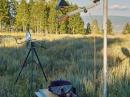
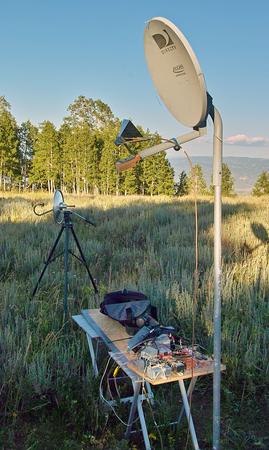
At about this time, Ron arrived at Inspiration point and began to set up. A few minutes after another unsuccessful attempt by Dale and I to make contact, I heard a burst of off-frequency SSB: Quickly retuning, I heard Ron's signal blasting through. Quickly re-peaking my antenna - a 18" DSS satellite dish - I called him and he came back, reporting that he was using just a 17dBi gain horn: This wasn't too surprising, as we already knew that out path was line-of-sight.
Following the easy 5x9 contact, Ron continued to work Dale, still on his omni and behind a mountain for Ron, until Dave appeared on 2 meters. Once he'd set up his gear he appeared on 10 GHz SSB as well: Being only about 20 miles away and line-of-sight, he had an extremely strong signal even with my antenna still pointed toward Ron, almost 180 degrees off his bearing.
Swinging my antenna and peaking, we more-or-less pegged each other's FT-817s and quickly turned our attention to having Ron and Dave try to work each other. At about 128 miles with mountains in the way, the first few attempts were unsuccessful until a strategy was decided: Being very near 11,900+ Mount Nebo, I would transmit a signal on which both Dave and Ron would peak their dishes, hoping for a reflection or refraction of some sort. This strategy worked and, despite a bit of random, deep QSB, they managed to work each other over the non line-of-sight path during the occasional, strong signal peaks.
As it was starting to get dark, we switched over to wideband 10 GHz FM. Using the DSS dish and with Ron using his 17dBi horn, we were able to work each other, verifying that our WFM gear was actually working, so we switched to 24 GHz WFM, but with no results: Not having proven our 24 gig gear as much as we had our 10 gig gear, we weren't entirely surprised - but this left us with further work to do!
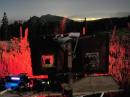
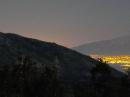
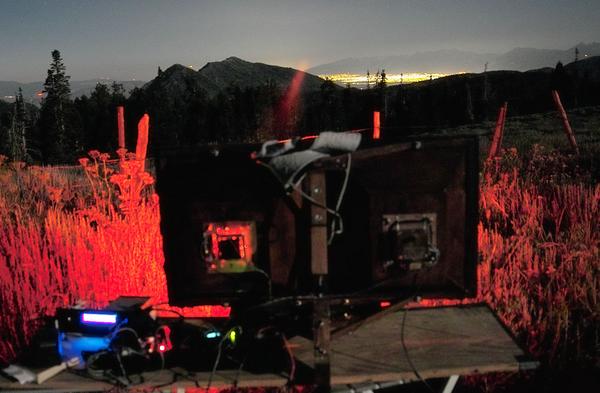
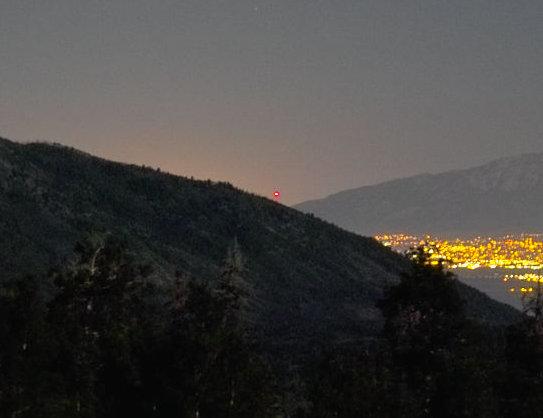
Failing 24 gig, we decided to try a higher frequency: The "Red" band! Even though it was fairly hazy, we could just make out the outlines of each other's mountains over the 107+ mile distance before it had gotten dark. Now, we wielded the high-power LED optical transceivers (each using a pair of large, acrylic Fresnel lens for both transmit and receive gain. It took only a few minutes before we established solid, full-duplex 2-way communications, despite the haze: Having managed to make a contact during last year's contest with far worse seeing conditions last year, we weren't too surprised that we were able to do this.
Unlike last year, where Ron and his team had to repeatedly retreat to avoid fierce thunderstorm cells, they had good weather (albeit cold - in the high 30's) and time to try another experiment: Bridging the 107+ mile gap using standard, cheap laser pointers.
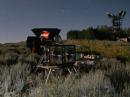
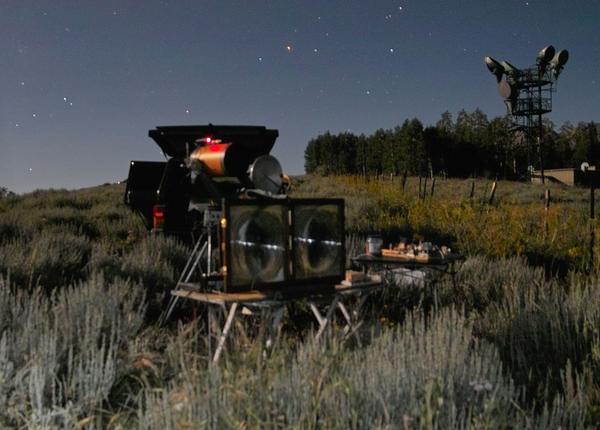
After some initial confusion trying to aim his laser using the electronic detection system, I was able to talk Ron to a reasonable aim by observing through my 8" reflector telescope: Once he had roughly aimed, we figured out what was wrong: He'd inadvertently disabled the laser's modulation of a reference tone required by the electronic system and once corrected, he quickly (and easily!) re-peaked his end.
Now it was my turn: Using my telescope as an Az/Al mount and using feedback from the detector system, I was able to quickly dial in his end and we established 2-way communications using cheap laser pointers modulated using PWM techniques.
Normally, the use of both coherent light and a small-diameter, uncollimated beam causes significant scintillation distortion. This time, however, the hazy air actually improved signals: Even though the haze caused significant attenuation (10-20dB) the airborne particulate matter caused a slight amount of beam scattering, quickly obliterating the original coherency of the laser beam, greatly reducing its deleterious effects. Even so, it was readily apparent that the signal quality of the LED system was noticeably better than that of the laser system - and it was a whole lot easier to aim!
(Further information on our optical systems may be found at the modulatedlight.org web site.)
73,
Clint, KA7OEI -- KA7OEI
While there wasn't exactly a pileup, there was about as much activity on 10 GHz this time as there ever has been: Bryan, W7CBM had enough time to try to find a clear area in the Salt Lake valley, Dale, WJ7L, was trying his luck with an omnidirectional slot antenna from home. Dave, WA7GIE, on a family outing, got a "KP" to go into the hills of central Utah while Ron, K7RJ and I went where we had gone during the first weekend of the 2007 contest: To "Inspiration Point" north of Ogden and at a location just off the Nebo Loop Trail above Payson, respectively - both of these sites being at about 9300 feet elevation and separated by 107.04 miles.
Shortly after arriving on-site, Dale appeared on the 2 meter repeater that we were using for coordination and we tried to make a QSO on a frequency 10 kHz below that of the WA7GIE beacon. Unfortunately, with a lot of dirt in between us (mountains entirely blocked my view of the Salt Lake Valley) I heard nothing from Dale.
At about this time, Ron arrived at Inspiration point and began to set up. A few minutes after another unsuccessful attempt by Dale and I to make contact, I heard a burst of off-frequency SSB: Quickly retuning, I heard Ron's signal blasting through. Quickly re-peaking my antenna - a 18" DSS satellite dish - I called him and he came back, reporting that he was using just a 17dBi gain horn: This wasn't too surprising, as we already knew that out path was line-of-sight.
Following the easy 5x9 contact, Ron continued to work Dale, still on his omni and behind a mountain for Ron, until Dave appeared on 2 meters. Once he'd set up his gear he appeared on 10 GHz SSB as well: Being only about 20 miles away and line-of-sight, he had an extremely strong signal even with my antenna still pointed toward Ron, almost 180 degrees off his bearing.
Swinging my antenna and peaking, we more-or-less pegged each other's FT-817s and quickly turned our attention to having Ron and Dave try to work each other. At about 128 miles with mountains in the way, the first few attempts were unsuccessful until a strategy was decided: Being very near 11,900+ Mount Nebo, I would transmit a signal on which both Dave and Ron would peak their dishes, hoping for a reflection or refraction of some sort. This strategy worked and, despite a bit of random, deep QSB, they managed to work each other over the non line-of-sight path during the occasional, strong signal peaks.
As it was starting to get dark, we switched over to wideband 10 GHz FM. Using the DSS dish and with Ron using his 17dBi horn, we were able to work each other, verifying that our WFM gear was actually working, so we switched to 24 GHz WFM, but with no results: Not having proven our 24 gig gear as much as we had our 10 gig gear, we weren't entirely surprised - but this left us with further work to do!
Failing 24 gig, we decided to try a higher frequency: The "Red" band! Even though it was fairly hazy, we could just make out the outlines of each other's mountains over the 107+ mile distance before it had gotten dark. Now, we wielded the high-power LED optical transceivers (each using a pair of large, acrylic Fresnel lens for both transmit and receive gain. It took only a few minutes before we established solid, full-duplex 2-way communications, despite the haze: Having managed to make a contact during last year's contest with far worse seeing conditions last year, we weren't too surprised that we were able to do this.
Unlike last year, where Ron and his team had to repeatedly retreat to avoid fierce thunderstorm cells, they had good weather (albeit cold - in the high 30's) and time to try another experiment: Bridging the 107+ mile gap using standard, cheap laser pointers.
After some initial confusion trying to aim his laser using the electronic detection system, I was able to talk Ron to a reasonable aim by observing through my 8" reflector telescope: Once he had roughly aimed, we figured out what was wrong: He'd inadvertently disabled the laser's modulation of a reference tone required by the electronic system and once corrected, he quickly (and easily!) re-peaked his end.
Now it was my turn: Using my telescope as an Az/Al mount and using feedback from the detector system, I was able to quickly dial in his end and we established 2-way communications using cheap laser pointers modulated using PWM techniques.
Normally, the use of both coherent light and a small-diameter, uncollimated beam causes significant scintillation distortion. This time, however, the hazy air actually improved signals: Even though the haze caused significant attenuation (10-20dB) the airborne particulate matter caused a slight amount of beam scattering, quickly obliterating the original coherency of the laser beam, greatly reducing its deleterious effects. Even so, it was readily apparent that the signal quality of the LED system was noticeably better than that of the laser system - and it was a whole lot easier to aim!
(Further information on our optical systems may be found at the modulatedlight.org web site.)
73,
Clint, KA7OEI -- KA7OEI
Photo Gallery
-
 My 10 GHz SSB sta...
-
 The high-power LE...
-
 The high-power LE...
-
 The optical stati...
Back