2009 ARRL Field Day
07/02/2009 |
K2LDC
This Field Day Was Different.
Fred Kruger, K2LDC
Every field day is unique. This time however, our in the neighborhood back yard operation was based on a Thursday decision, when our clubs Field Day plans fell through. Think emergency activation without knowing when or how many of the notified/invited fellow hams would arrive to help. On Friday, I sent out a press release and an email invitation to Pat Biancaniello, an elected member of the Smithtown NY Town Council. This was our pre-Field Day preparation as we started our Saturday morning set-up.
Once it was clear that there would be no club operation this year, I invited several club members to operate with me and my wife Barbara (WA2VQJ), in our backyard. We didnt know whether we would be the only operators, or if some of the club members who said they would drop over to operate would actually appear. We also didnt know when people would arrive. With solar panel charged batteries available, Barbara and I agreed that we would simulate emergency conditions and operate the entire time on the batteries--- as long as we had sun and a charge on the batteries.
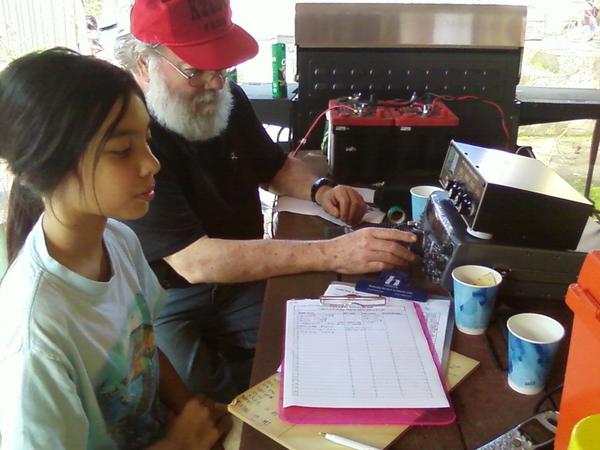
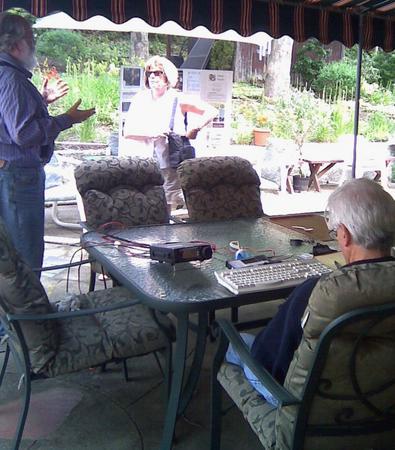
If we couldnt keep the batteries charged by the sun, we would use our small gas generator. I wasnt sure since the weather forecast wasnt for bright sun. We did agree, however, that if it got too cloudy, we would drop transmitter power to a much lower level and try to avoid generator use. As it turned out, we decided to compromise and wound up using the TS-2000 transceiver set for about 65 watts, for all SSB (phone) operation and an IC-703+ set for 5 watts and connected to a NUE-PSK modem for digital (PSK-31) operations. We never used the generator to power our station! Our entire operation was solar/battery powered. Each transceiver was powered by a separate solar charged battery system (We knew that the IC-703 could be run at the 5 watt level for days, even without bright sunlight, using the system to which it was connected.)
Our primary antenna was a 40-meter dipole strung between two trees, with an external tuner used during 20- meter operations. For 20 and 40 meter PSK-31 activity, we used a Super Antenna manual screwdriver type vertical antenna clamped to a steel fence post.
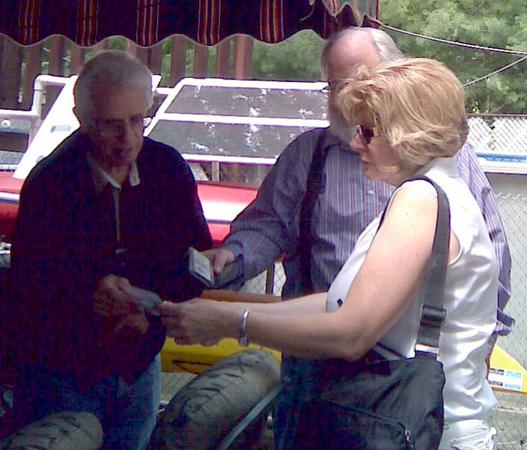
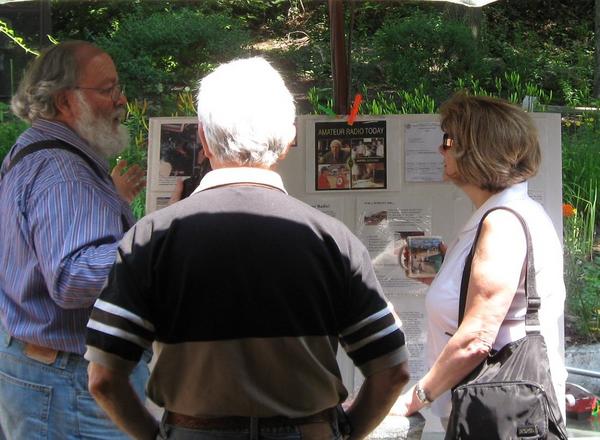
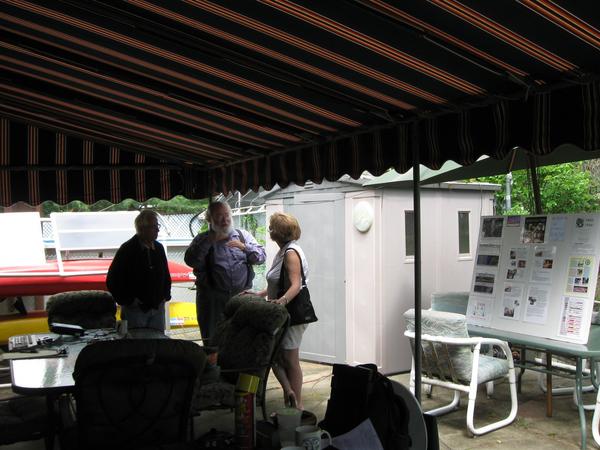
We set up a public information display and included a number of different ARRL brochures introducing ham radio from different viewpoints. Five of our neighbors came to our operation to learn first hand about a ham radio and several Girl Scouts visited and asked questions. We told them about Field Day and we talked about many of the different aspects of ham radio. With this operation, we emphasized our various public service roles and, when necessary, our emergency role as providing the last mile of communication when other communication systems failed.
Sunday morning, one of our elected town council members, Pat Biancaniello, appeared in response to our invitation. We showed her how we were operating under simulated emergency conditions using only solar and battery power. Moreover, we explained that the antennas being used were very portable and could be easily set up in the field, if necessary. We talked about HF communications and discussed why we use VHF/UHF repeaters. She asked many other questions about ham radio activities, and what was required to earn a license.
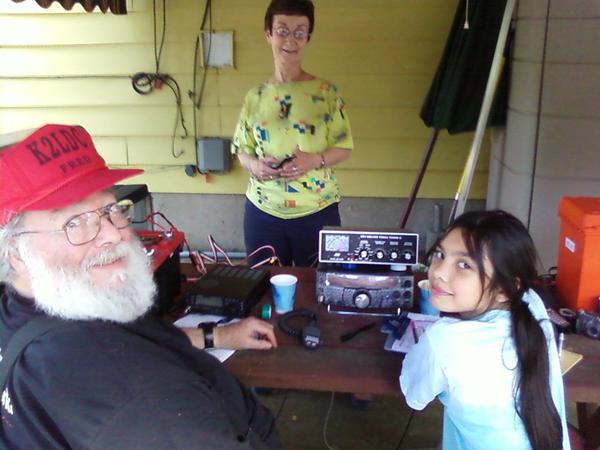
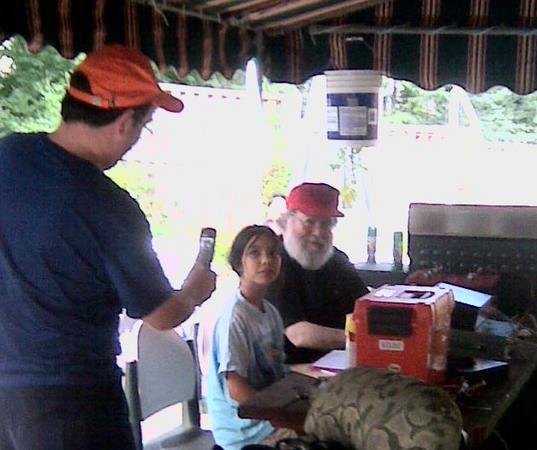
A total of six hams (K2LDC, WA2VQJ, KC2OJO, AA2XK, W2SWR, KC2MSH) operated at our field day site at different times. A total of eleven other people visited and observed our activities, asked questions, and received printed ham radio related information sheets. Two of the non-ham visitors were Jennifer and Rachel, the daughters of Mike, W2SWR, and Chatthip, KC2MSH (Girl Scout Troop Leader). We discussed everything from crystal sets to ham satellites, to speaking with astronauts on the space shuttle or the space station. We told our visitors how ham radio was a great hobby for kids and how there's no phone bill at the end of the month!
When Field Day ended and we were disassembling the outdoor stations, several of us reviewed what had been accomplished. Within a short period of time we had assembled the backyard field day site, notified neighbors about the event, and even invited a local town official who had previously expressed interest in emergency preparedness and ham radio involvement, to observe and ask questions. We had a very basic food menu, we used simple antennas, and we used one moderate power SSB transceiver and one low power digital transceiver. We didnt really make a lot of contacts. Still, we enjoyed ourselves and had a successful operation; even if our total score was quite low. I definitely believe that our town councilwoman and our neighbors learned a lot about the many aspects of the hobby of ham radio, including our public service activities and our ARES/RACES operations under emergency conditions, or in a real emergency. -- K2LDC
Fred Kruger, K2LDC
Every field day is unique. This time however, our in the neighborhood back yard operation was based on a Thursday decision, when our clubs Field Day plans fell through. Think emergency activation without knowing when or how many of the notified/invited fellow hams would arrive to help. On Friday, I sent out a press release and an email invitation to Pat Biancaniello, an elected member of the Smithtown NY Town Council. This was our pre-Field Day preparation as we started our Saturday morning set-up.
Once it was clear that there would be no club operation this year, I invited several club members to operate with me and my wife Barbara (WA2VQJ), in our backyard. We didnt know whether we would be the only operators, or if some of the club members who said they would drop over to operate would actually appear. We also didnt know when people would arrive. With solar panel charged batteries available, Barbara and I agreed that we would simulate emergency conditions and operate the entire time on the batteries--- as long as we had sun and a charge on the batteries.
If we couldnt keep the batteries charged by the sun, we would use our small gas generator. I wasnt sure since the weather forecast wasnt for bright sun. We did agree, however, that if it got too cloudy, we would drop transmitter power to a much lower level and try to avoid generator use. As it turned out, we decided to compromise and wound up using the TS-2000 transceiver set for about 65 watts, for all SSB (phone) operation and an IC-703+ set for 5 watts and connected to a NUE-PSK modem for digital (PSK-31) operations. We never used the generator to power our station! Our entire operation was solar/battery powered. Each transceiver was powered by a separate solar charged battery system (We knew that the IC-703 could be run at the 5 watt level for days, even without bright sunlight, using the system to which it was connected.)
Our primary antenna was a 40-meter dipole strung between two trees, with an external tuner used during 20- meter operations. For 20 and 40 meter PSK-31 activity, we used a Super Antenna manual screwdriver type vertical antenna clamped to a steel fence post.
We set up a public information display and included a number of different ARRL brochures introducing ham radio from different viewpoints. Five of our neighbors came to our operation to learn first hand about a ham radio and several Girl Scouts visited and asked questions. We told them about Field Day and we talked about many of the different aspects of ham radio. With this operation, we emphasized our various public service roles and, when necessary, our emergency role as providing the last mile of communication when other communication systems failed.
Sunday morning, one of our elected town council members, Pat Biancaniello, appeared in response to our invitation. We showed her how we were operating under simulated emergency conditions using only solar and battery power. Moreover, we explained that the antennas being used were very portable and could be easily set up in the field, if necessary. We talked about HF communications and discussed why we use VHF/UHF repeaters. She asked many other questions about ham radio activities, and what was required to earn a license.
A total of six hams (K2LDC, WA2VQJ, KC2OJO, AA2XK, W2SWR, KC2MSH) operated at our field day site at different times. A total of eleven other people visited and observed our activities, asked questions, and received printed ham radio related information sheets. Two of the non-ham visitors were Jennifer and Rachel, the daughters of Mike, W2SWR, and Chatthip, KC2MSH (Girl Scout Troop Leader). We discussed everything from crystal sets to ham satellites, to speaking with astronauts on the space shuttle or the space station. We told our visitors how ham radio was a great hobby for kids and how there's no phone bill at the end of the month!
When Field Day ended and we were disassembling the outdoor stations, several of us reviewed what had been accomplished. Within a short period of time we had assembled the backyard field day site, notified neighbors about the event, and even invited a local town official who had previously expressed interest in emergency preparedness and ham radio involvement, to observe and ask questions. We had a very basic food menu, we used simple antennas, and we used one moderate power SSB transceiver and one low power digital transceiver. We didnt really make a lot of contacts. Still, we enjoyed ourselves and had a successful operation; even if our total score was quite low. I definitely believe that our town councilwoman and our neighbors learned a lot about the many aspects of the hobby of ham radio, including our public service activities and our ARES/RACES operations under emergency conditions, or in a real emergency. -- K2LDC
Photo Gallery
-
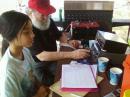 K2LDC with young ...
-
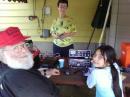 K2LDC and WA2VQJ ...
-
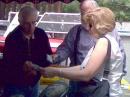 K2LDC and KC2OJO ...
-
 Howard,KC2OJO, op...
-
 K2LDC answers som...
-
 K2LDC and KC2OJO ...
-
 Mike (W2SWR) take...
Back