2018 ARRL January VHF Contest
After 61 years on the air, I keep saying it's time to give up VHF contests--or at least give up roving. But I keep letting myself be persuaded to do "one more rove." Maybe it doesn't take much persuading...
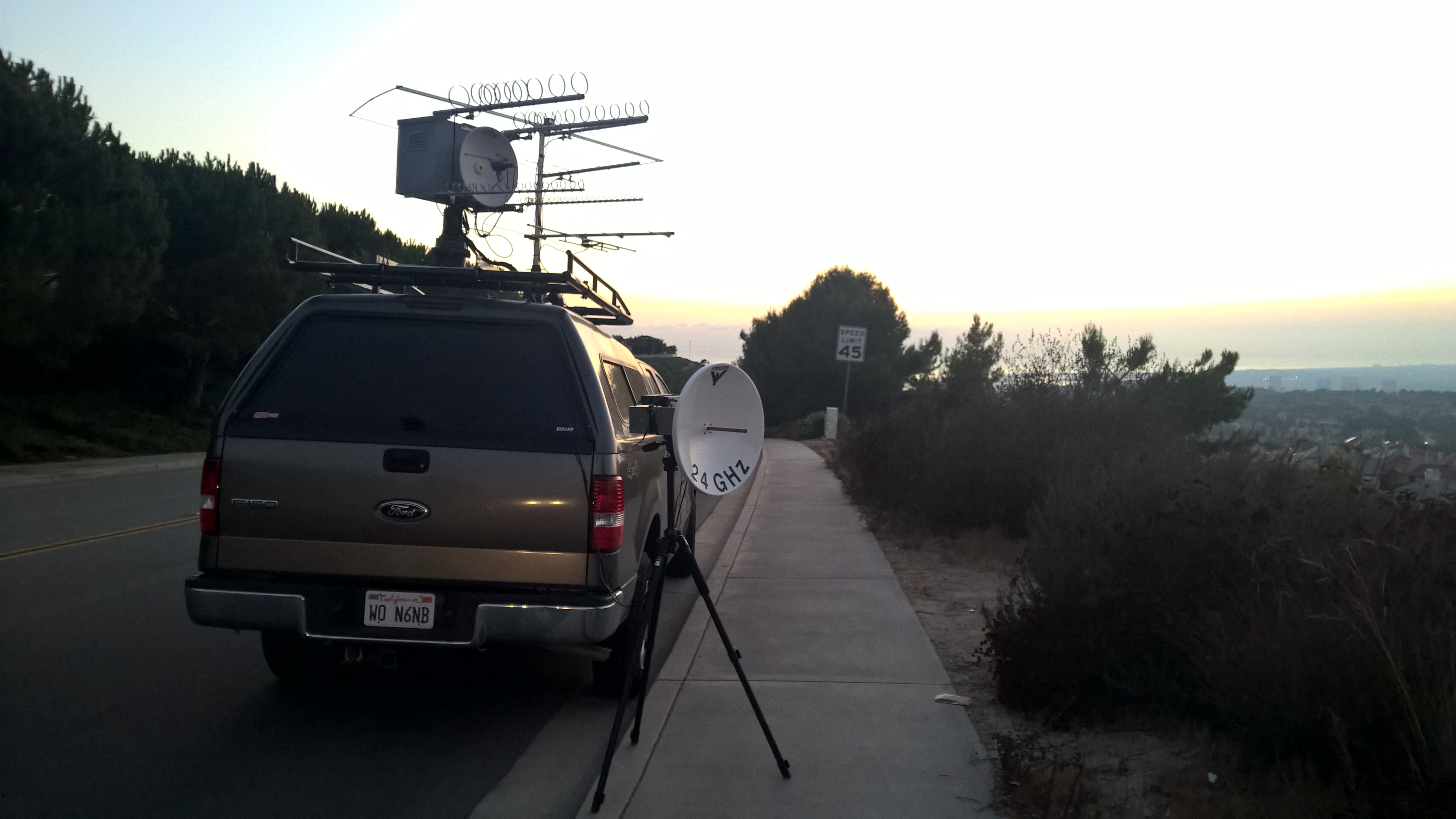
January 2018 turned into a 10-grid adventure with four 11-band rovers and three well-equipped fixed stations tracking us as we moved. I (N6NB/R) was joined on the road by three friends from the Fresno area, K6MI/R, N6MTS/R and W6TE/R. Meanwhile, N6TEB and K6WCI were guest operators at my 11-band fixed station in Panorama Heights (DM13), signing W6TOI, the Downey Amateur Radio Club call sign. W6IT celebrated the completion of his 10-band home station by also following the rovers, working us easily on 50 MHz through 10 GHz in several grids. He got the last of his 10 VHF+ bands, 2.3 GHz, running with full performance a few weeks before the contest. W6TV, a fixed station on Bear Mountain east of Fresno, also followed us on all bands from six meters through 24 GHz. Thanks once again, Pat and Rob.
We started our rove in Orange County and moved through the four Los Angeles grids before crossing the Tehachapi Mountains to rove Saturday night and Sunday in the San Joaquin Valley. The high point was finishing the contest with good scores and with no major mishaps along the way. But there were low points, such as getting stuck in the mud in CM95 at 1 a.m. Sunday. The road to a prime hilltop turned out to be really muddy from recent rains. Even with his four-wheel-drive truck, N6MTS/R had a tough time getting out of mud that flew everywhere off his spinning wheels. At least it was delicious mud. W6TE/R also ended up in a mud hole, but his outcome was even worse: Once he got onto dry ground he couldn't get his newly overhauled transmission back into two-wheel-drive for a frightening 15 minutes. Then a road closure delayed our arrival in Fresno past 3 a.m.--at which point I started looking for a hotel with a vacancy. I had been expecting to stay in Kettleman City, so I had no reservation in Fresno. I found a room at 3:30 a.m., luckily. Sometime around 3:10 a.m. I was telling myself I'm much too old to be on the street alone looking for lodging at that hour.
This contest also marked my first successful use during a rove of the hugely popular new digital mode, FT8. I had a laptop computer on the passenger seat of my truck and I set the time (a critical part of FT8) by monitoring WWV and tapping the Windows time button quickly enough to have the computer clock within 0.2 seconds of right on. Many FT8 users have found that even being half a second off the exact time makes decoding difficult. The best way to set a computer to the exact time is by using a network time server online, but as a rover I had no internet access. Fortunately, WWV is still there.
The use of FT8 during the January VHF contest turned out to be surprisingly controversial. Afterward the contest reflector had many posts protesting FT8 as too slow and a distraction that siphoned off operators. That left me with a real sense of deja vu. I remember when SSB first became popular on VHF, supplanting AM phone in VHF contests. There were passionate protests about SSB from AM devotees in the 1950s and 1960s. Then FM came along and siphoned off still more of the people who were once on AM. The protests became even more intense when some VHF contesters (including me) followed the crowds to FM and began working VHF contests on the FM simplex channels 40 years ago. Today some people feel much the same about FT8 as a VHF contest mode, despite the fact that it is attracting many new people who have never worked VHF contests on SSB or CW. That, plus the obvious fact that FT8 makes it possible to work weak signals that cannot even be detected on CW or SSB, means FT8 (and other digital modes) should be a key element of a winning VHF contest strategy, just as SSB became a key element 50 years ago. Granted, a good operator can maintain a better rate on SSB when six meters is wide open, but much of the time FT8 produces more Qs and certainly more multipliers than SSB/CW alone. That's especially true outside the activity-rich northeast corridor. I think FT8 or other digital modes will be a major factor in future VHF contests long after I park my rover for the last time.
Photo Gallery
-
 This photo, taken...
Back