-
Power Lines
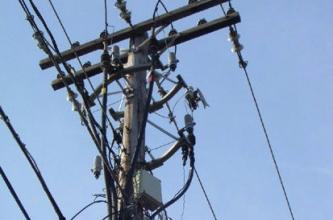
Power lines can be a significant source of RFI, and can take hams off the air for extended periods of time. ARRL encourages hams to raise suspected power line noise with their power companies and to seek ARRL's help if they are unable to get the matter resolved on their own. -

Solar
Solar is becoming increasingly more popular, amongst hams and their neighbors. With the increase in solar installations, the ARRL has been fielding many questions on addressing RFI issues. ARRL has developed relationships with several solar developers, in an effort to minimize harmful interference to amateur radio stations. -
Lighting Devices
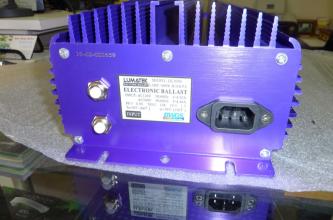
ARRL gets numerous reports of RFI from lighting devices, due to the increase in energy efficient LED lighting, and the increase in the use of grow lights that can rely on high power ballasts for their operation.
RFI News & Events
Recommended Practice 1897 Now a Reality - On September 20, 2024, the Institute of Electrical and Electronics Engineers (IEEE) released Std 1897™-2024, a recommended practice for locating sources of radio frequency interference (RFI) from power lines. Long in the making, this document is an effort to help utilities and others, including radio amateurs, better address cases of harmful interference to radio spectrum. In addition to detailed information on modern noise locating equipment and techniques, it includes information on the causes and effects of power line noise, FCC rules and requirements plus recommended complaint handling procedures for utilities. For those wishing to purchase the recommended practice, it is linked here: https://standards.ieee.org/ieee/1897/6837/
Frequently Requested RFI Reference Materials
- A sharable PDF describing ARRL's RFI Program which can be made into a trifold can be accessed from this link.
- I have RFI, now what? Locating RFI by Dave Cole, NK7Z.
- Locating RF Interference at HF. A proven and practical approach to dealing with RFI from grow lights and more, by Tom Thompson, W0IVJ. QST November 2014, p 33.
- How to choose ferrite components: Fair-Rite technical reference.
- A Ham's Guide To RFI, Ferrites, Baluns, And Audio Interfacing by Jim Brown, K9YC.
- Palomar Engineers RFI solutions
- RFI Services: Locating Inside RFI Sources
ARRL's Role in RFI Investigations
ARRL helps amateur radio operators through both technical and process hurdles often experienced while investigating RFI to or from a ham’s station. Most assistance, well over ninety-five percent of assistance from the ARRL, is due to interference to an amateur radio station. There are very few instances where ARRL is called upon for assistance, and the radio amateur is causing the RFI.
So how does ARRL help with RFI investigation? First, ARRL provides technical assistance in finding the source of the RFI, whether its coming from a device in the amateur radio operator’s own home, a neighbor’s home or power lines, ARRL can help by working with ham’s to identify the RFI through the characteristics of the noise source, helping with Direction Finding (DF’ing) techniques and in advising ham’s on how to approach their neighbors when the noise appears to be coming from a neighboring home.
ARRL can also help with process issues. For example, ARRL can help with interpreting FCC rules & regulations, and under ARRL’s cooperative agreement with FCC, ARRL can often document RFI problems on behalf of amateur radio operators through the transmittal of a letter to the individual or corporation responsible for the operation of the RFI source. If ARRL’s efforts do not yield sufficient results, ARRL can work to bring about a resolution through FCC involvement. In most cases, RFI issues are resolved even before ARRL writes a letter to the individual or corporation causing the RFI. Further, there are very few cases that need to have formal FCC involvement to bring about a resolution.
Investigating RFI Issues
In the course of investigating RFI issues, two questions are frequently asked of us at the ARRL lab. The first is generally “what does this RFI sound like to you?” And the second, “what does this RFI look like to you?”
Aside from a few very distinctive types of RFI (for example, power line noise), it is difficult to identify what specific device is causing interference based on the sound it produces, or the visual signature in a waterfall. In fact, the most useful question to ask first regarding interference isn’t necessarily “what is producing this interference?” but “where is this interference coming from?”
Once the source of RFI is determined to be coming from a specific location, the process of identifying the actual device causing issues can be less of a challenge. Even knowing, without a doubt, that the source of RFI might be an LED light, its impractical to ask all of your neighbors if they have one of those lights. They may not know the make/model of all their bulbs, and to make matters worse, the RFI might be coming from another neighbor's home. While clues about what might be causing RFI are helpful, ARRL advises hams to prioritize and do their best to track down where the RFI is coming from, if that is practical and safe to do.
While some common causes of RFI might be power lines and devices in others' homes, many of the RFI cases that come through ARRL are found to be in the amateur’s own home. Never underestimate the power of simply taking a trip to your circuit breaker box and cycling cicuit breakers while listeninng with a portable radio to see if having a circuit off cures your RFI problem. This can be the best first step when determining where your RFI might be coming from.
In summary, you should follow this general process if you have an RFI issue at your station:
- Keep a record of when the RFI started, what bands/modes you hear it on, and document the symptoms;
- Focus on "where" the RFI might be coming from, rather than "what" the RFI might be;
- Do some work on your own to ensure the RFI isn't coming from your home, such as the circuit breaker test described above;
- If you can, perform some DF work on your own (or with a fellow ham) to try and locate the source of the RFI. One simple test is "sniffing" with a portable radio to try and locate the source of the RFI. Further reading can be found at the links below under articles;
- If you contact a neighbor, a utility or other company regarding the RFI, it helps to keep a record of those conversations/contacts; and
- If you are going to reach out to ARRL for help, we encourage you to make a recording of the RFI, generally 30 - 60 seconds in AM and SSB, this can be helpful in RFI investigations. Programs such as Audacity can be a useful tool for examining the spectral characteristics of the RFI you are experiencing, and new tools such as Software Defined Radio (SDR) and integral spectrum scopes can also be helpful in analyzing potential noise sources.
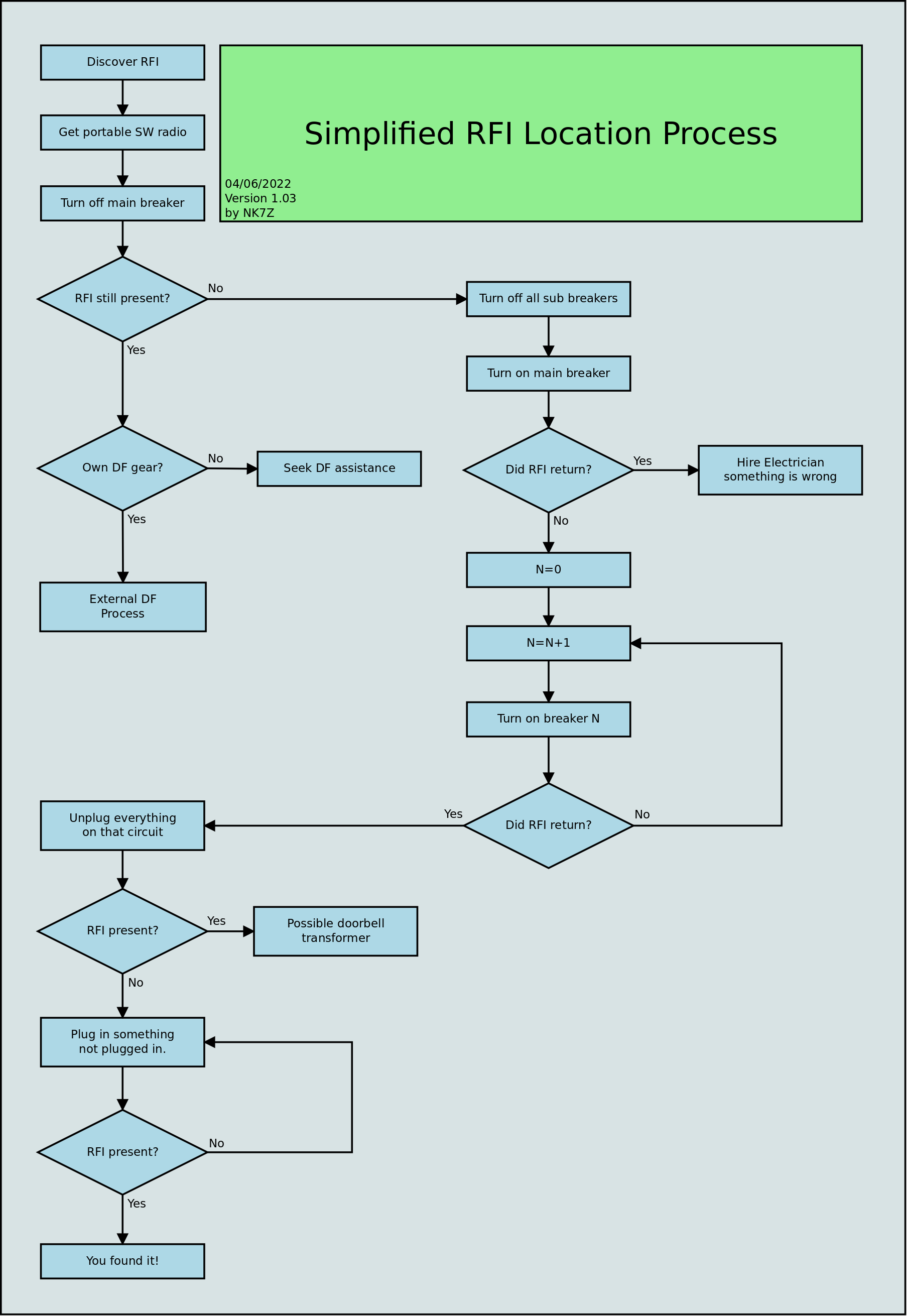
Lastly, note that Dave Cole, NK7Z, an ARRL Technical Specialist, has a helpful flow chart for locating RFI on his web site. And if you need some assistance from ARRL, feel free to contact our RFI Engineer.
RFI Teams
The ARRL encourages and supports the formation of local RFI teams. Examples of such teams are those in Florida's Platinum Coast Amateur Radio Society (PCARS), serving hams located in the Melbourne, FL area and in the New England Division. Links and a description of RFI activities are below. If you need RFI assistance and live near one of these RFI Teams, you can contact them directly. If you don't, see the next section, "Getting ARRL's Help."
- Platinum Coast ARS sponsors a group of dedicated and capable volunteers to help hams locate RFI and find solutions to RFI issues, both to and from communications systems.Volunteers share direction finding techniques and meet regularly with a national group working on RFI issues. PCARS has developed a repository of problems encountered, best practices and contact information for local power company officials.
- The New England Division also has several teams consisting of volunteers to help hams locate and solve RFI issues. The division has a an active web page which includes a link to an intake form for use by hams in the New England Division.
ARRL divisions and sections can contact the ARRL RFI desk if they would like to have a local RFI team added to this list. RFI teams are independent groups built to server their local communities. It should be noted however, that pursuant to ARRL's cooperative agreement with the FCC, only ARRL can work directly with the FCC on pursuing RFI cases beyond informal, local level resolution.
Getting ARRL's Help
If you need ARRL's help in either investigating RFI from or to your station, we are just a phone call or an e-mail away. You can reach our RFI Desk at (860) 594-0200, or through e-mail to RFI@arrl.org. To make the best use of our time, we also request that radio amateurs opening up an RFI case with ARRL complete one of the following two forms, as may be applicable to your particular RFI case:
Web Links
- I have RFI, now what? Locating RFI by Dave Cole, NK7Z.
- A Ham's Guide To RFI, Ferrites, Baluns, And Audio Interfacing by Jim Brown, K9YC.
- Audio Systems Group, Inc. Publications
Provides a number of articles and application notes related to sound systems. Some of these articles pertain to interference to audio systems from both power and RF sources. - The EMI - RFI Page, by Mark Demeuleneere, ON4WW. In this page, Mark provides some interesting background on some of his more memorable RFI experiences in Belgium. As Mark puts it, “It took quite some time just to document these RFI cases. Imagine how much more time was invested in finding and solving them!”
- The EMI - RFI Page, by Chris Gare, G3WOS.
- Variable Speed DC Motor Washing Machine RFI Fix, by Gene Preston, K5GP.
- Grow Light Electronic Ballast RF Interference, by W0QE.
- eEngineer provides an EMI/EMC Glossary as well as several other RFI pages pertaining to RFI.
- Lutron provides Applications Notes
- V-Soft Communications® LLC
Provides AM FM Zip Code Based Signal Strengths: Field strength vs. Zip Code - Welcome to the RSGB EMC Web Pages
E-book-"The RSGB Guide to EMC" (Electromagnetic Compatibility) - Center for Devices and Radiological Health
Addressing EMI in medical devices
Naval Postgraduate School RFI Handbooks
Special thanks to George F. Munsch, W5VPQ for providing these documents. They contain useful and comprehnsive information for both RFI locating and noise mitigation. By Wilbur R. Vincent, W6PUX, George F. Munsch, W5VPQ, Richard W. Adler, K6RWA, and Andrew A. Parker, WV1B.
- Power-Line Noise Mitigation Handbook for Naval and Other Receiving Sites
This is a comprehensive manual that describes how to understand, locate and correct power line noise. A must for every utility or RFI troubleshooter. - The Mitigation of Radio Noise And Interference From On-Site Sources at Radio Receiving Sites
Provides information when sources are located within the boundaries of a site. In most cases, these sources are electrical or electronic consumer devices.
Articles
What Is It? While this question may seem intuitive, it may be the wrong one to ask if you have an RFI problem. By Ed Hare, W1RFI.
Electronic Noise Is Drowning Out the Internet of Things. Our increasingly connected world needs better protection against RF noise pollution, By Mark A. McHenry, Dennis Roberson & Robert J. Matheson. IEEE Spectrum, August 18, 2015
Hunting Down RF Noises. Find noise sources both outside and inside your home with a systematic approach, by Michael Foerster, W0IH. QST February 2015, p 45.
Locating RF Interference at HF. A proven and practical approach to dealing with RFI from grow lights and more, by Tom Thompson, W0IVJ. QST November 2014, p 33.
A Quick Look at Radio Frequency Interference, by Joel R. Hallas, W1ZR. QST May 2009, p 61.
Interference Primer - Parts 1 and 2 Derived from QST Lab Notes columns. Contains general information on Radio Frequency Interference.
RFI: ARRL Laboratory On Television--WATCH!
ARRL's Ed Hare, W1RFI and Mike Gruber, W1MG talk about RFI problems on a Common Point, a Cable Access TV show hosted by Dan Thomas. Mr. Thomas serves on the Board of Directors of the Vintage Radio and Communications Museum of Connecticut (VRCMCT). Associate Producer: ARRL Assistant Laboratory Manager, Bob Allison, WB1GCM.
Identifying & Locating Power Line Noise, Produced by the ARRL Laboratory, written and directed by Bob Allison, WB1GCM and narrated by Jerry Ramie, KI6LGY
Power Line RFI Investigation in Pleasant Hill, California, Video of an RFI Investigation in Pleasant Hill, California.