Students at work
More Comments
-
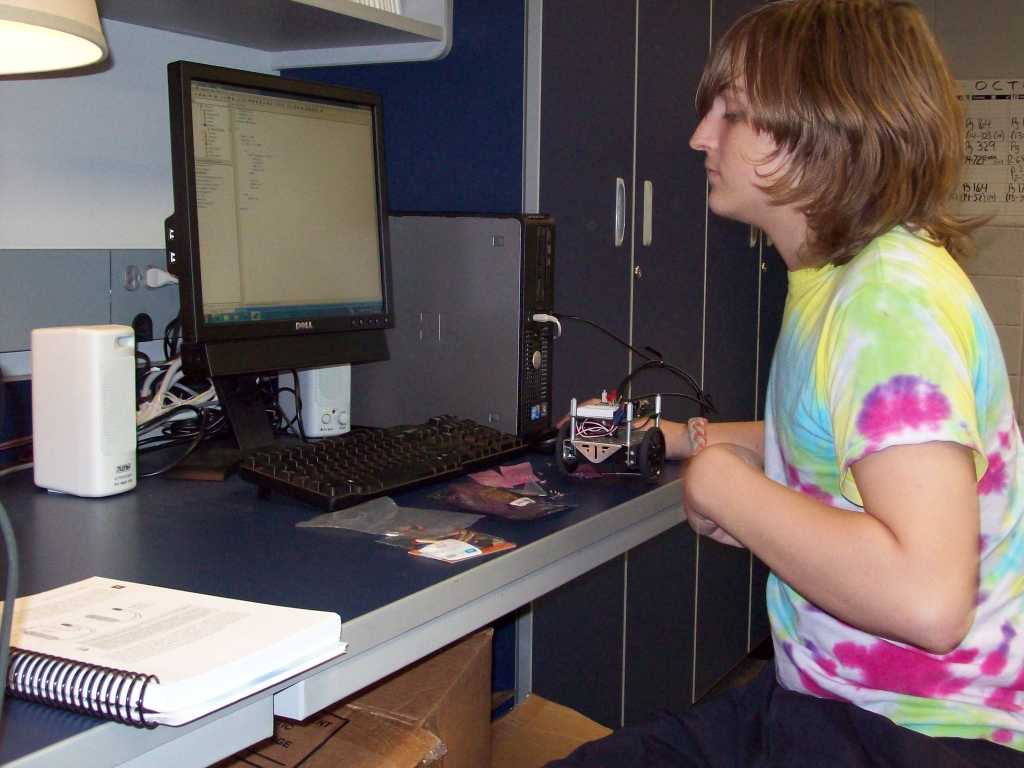
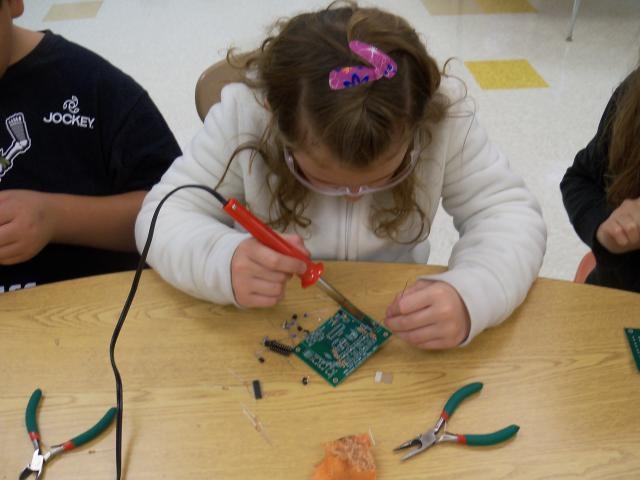
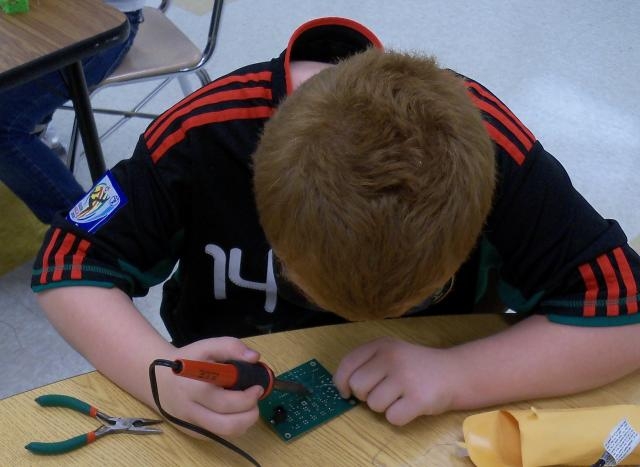
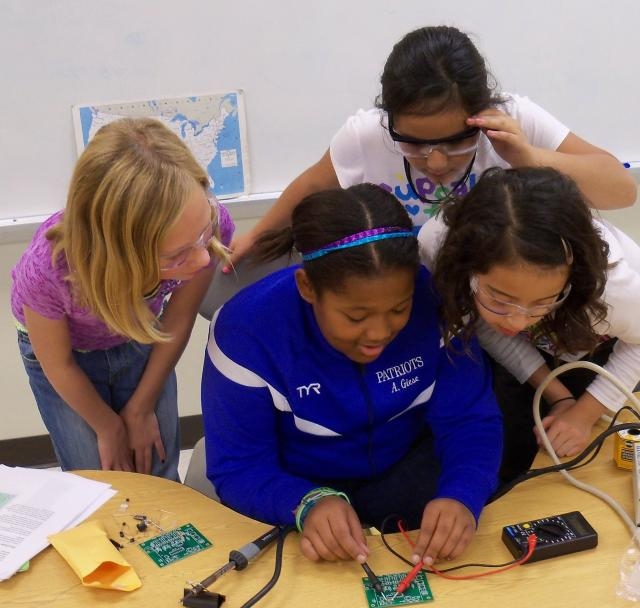
Students at New Mexico Tech Employ Microcontroller Programming
Dec. 25, 2014 - The training and resources [from the Teachers Institute] have worked out great in the classrooms and laboratories I manage. I teach chemical engineering at New Mexico Tech, and tutor at Magdalena School, and the Boys' and Girls' Ranch, a high school for students whose parents are caught in the legal system. A few milestones this year:'
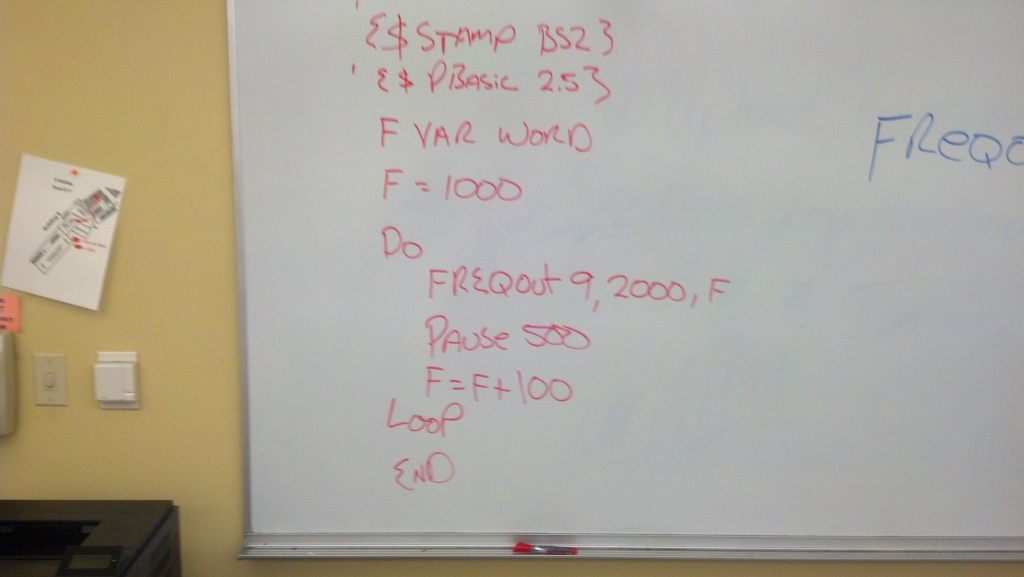
1. At NMT, I added a project to the Instrumentation class that required all students to program the Parallax Stamp II Microcontroller.
2. At NMT, a group of students will enter the regional Chemical Engineering Car competition for AIChE. They will likely use a Stamp II board to control the motion of the car.3. At the Boys' and Girls' Ranch, I created a 1.5 hour demo where the students could build circuits with LEDs, batteries, and resistors on prototype boards.
4. At the Boys' and Girls' Ranch, I created a 1.5 hour demo where students programmed a 7-segment LED using the Stamp II board.
5. I started AVID tutoring at Magdalena School. In the spring semester, I will begin working with their Mathematics, Engineering and Science Achievement (MESA) program, which often involves robotics and microcontroller programming.
NMT: ~36 students
Boys' and Girls' Ranch: ~30 students
Magdalena School: ~20 studentsSeth Price, N3MRA
New Mexico Institute of Mining and Technology
Socorro, New Mexico
-
September 2013- I wanted to give you an update on my classroom activities as it relates to TI-2-Remote Sensing. I started a unit on binary numbers last week. We converted to decimal and back and forth. Now we are taking a quiz today with a test on electronics history and binary later this week. Next week we will touch on Hex and move to and 8th grade lesson on ADC. We will be moving into sampling right after that as we did in class, and finally move into binary searches. This is all a prelim into my electronics unit. I am going for my national board certification and will use the electronics as my primary source for that certification. More lessons are coming.
March 2013- “I had a kid a few months ago tell the principal that this (STEM class electronics lesson) is the first time he has ever had to use Algebra outside of math class... and enjoyed it. The other was the other day when I had 2 kids randomly tell that "Hey you know those electronics we studied... it really helped me in science class. It all made sense in class."
--
Bill Richardson, N5VEIOlde Towne Middle School, Ridgeland, MS
-
KY Technology School Plans Space Curriculum
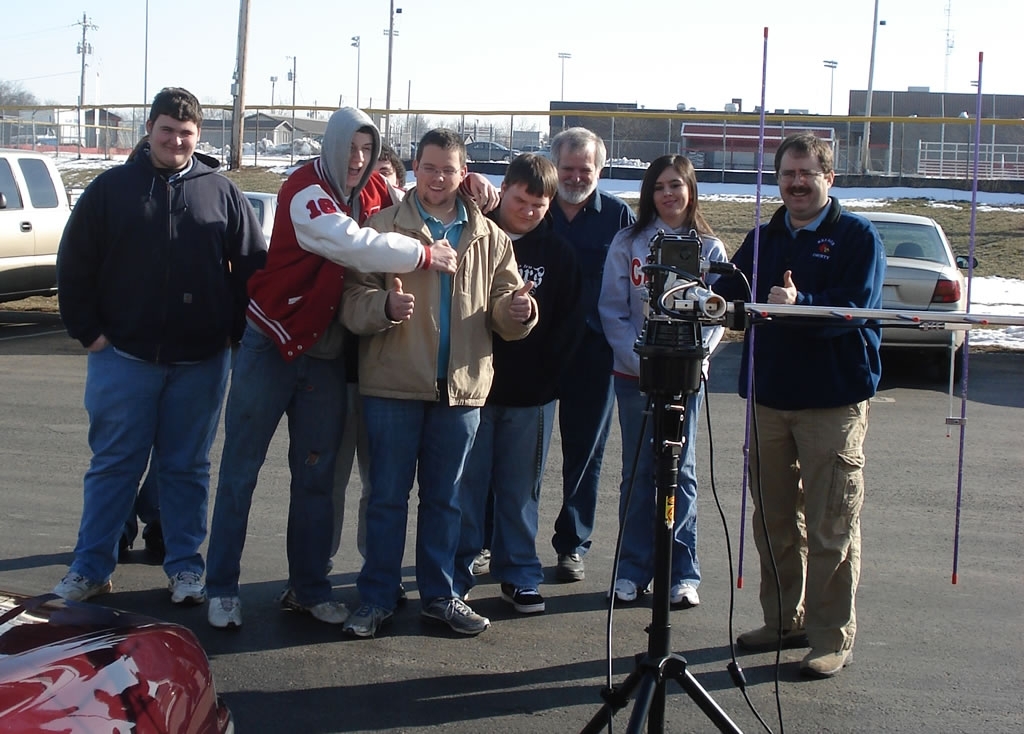
Feb. 2010- "Finally the weather broke and success! A big thumbs up from both KI4RDT and KJ4LIV from EM77 for successful QSOs with YV5DSL in FK60nk Caracas, Venezuela off satellite HO-68. It was a lower pass but was successful which makes it all the sweeter. Pictures are from my Cisco Internetworking class including KJ4LIV, KJ4LIU, KJ4PIY and Chris Brown HVAC instructor assisting. Also pictured is Charlie Cantrill (KI4RDT) instructing TC (KJ4LIV) in use of satellite ops. Next time we hope to hook up the TNC to get telemetry."
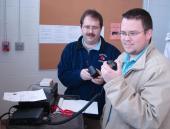
Sept. 2010- "Four Amateur radio licensed Nelson County Students and their instructor Mr. Cantrill just talked to the International Space Station NA1SS with Astronaut Col. Wheelock via Amateur radio. This was a high elevation pass and the tracking system was used. ARISS Rocks! I almost cried though when I realized our voice recorder battery was dead."
Oct. 2010- "We have a Gulf Alpha 5 element circularly polarized antenna that is going to be installed shortly. We have a club call now KJ4YSU, but are waiting for our vanity. Also, I made it to the AMSAT symposium. I had the privilege of Bob Twiggs riding shotgun with me and 4 grad students from Kentucky Space.
See what you got started?
Thanks for all your help!"
Charlie Cantrill, KI4RDT
Information Technology Instructor
Nelson County Area Technology Center
-
Alabama Students Participate in Balloon Launch, Welcomed On-the-Air by Local Hams
August 2013- Fifth grade teacher Jackie Smith, KJ4SVQ, shared these comments with her Teachers Institute instructor, Matt Severin, N8MS:
"My 5th graders launched and recovered a high altitude balloon in May. We had some problems along the way, but I see where we can make some changes and improvements. I wrote a grant to continue the project for the upcoming school year and just found out that I will receive funding by the end of this month. I really wanted to attend the remote sensing workshop this summer, but was unable to apply because of scheduling conflicts. Hopefully, that will work out for next summer.
My students have also made a lot of radio contacts who were eager to talk to young people about ham radio. We made one contact who was so excited about talking to the kids that he actually drove over to the school and did an impromptu Q & A session with the kids. They loved it!"Jackie Smith, KJ4SVQ
Columbia Elementary School, Madison, AL
-
Samsula Radio Panthers use Electronics Learning Lab Kit
Barbara Vola from Samsula Academy reports to Mark Spencer, WA8SME, Education and Technology Program Coordinator of the ARRL, on what the Radio Panthers have been doing during this school year.
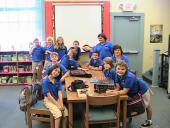 "We have done some wonderful things with the Radio Panthers this year. A volunteer from our local lighthouse (who is also a Ham) came out and taught the kids about wireless communication over the years, and then we built our own Morse Code oscillators. He made up kits and we walked the kids through them. Then they practiced coding messages and sending them to each other. They then had to decode the messages they received. What a ball that was! Anyway, I would like to make that a yearly event, so I have included them on the wish list.
The Radio Shack Electronics Learning Lab is probably the best of all the kits we acquired this year. The kids are learning about resistors and are using them in that kit. The kits from Ramsey don't have separate resistors so the kids have to look at their bands and figure out how many ohms of resistance they are. They have really been doing well with this this year. Thank you for your generosity to our program!.”
http://samsularadiopanthers.blogspot.com/
-
Basic Electronics Course helps explain fundamental concepts
"The Basic Electronics Course Power-Point sildes have been used in Electronics and Computer classes specifically to demonstrate multimeter usage. The pictures make explaining VOM usage straightforward and easier for the students to understand. I have used the 'Modulation and Wave Fundamental' and 'Building Blocks Activity' demonstration boards during FCC amateur radio licensing classes for the local amateur radio club in conjunction with a spectrum analyser to show various signals. "
Jerry T. Taylor, Hub Area Technical School
South Dakota
-
TI teaching model helps teach electronics with a deeper understanding
"I taught Sophomore Electrical with a deeper understanding this past school year. This was because of the teaching model I was shown last year in the TI class, and the topics covered in class. In the model the student not only is lectured, but they must do laboratory work on what they learned (hands-on). They must trouble shoot problems that may come up, record their findings, and make sense of the findings with the assistance of the teacher. This opens the door for the next topic. Using lecture/laboratory as a technique the student gains an understanding of electricity that is more than just the math of it, they have fun learning also. I used the teaching model shown me last year in my classroom this past year."
Gordon Williams, Brooklyn Technical High School
New York
-
TI training helped establish Amateur Radio & Technology Club
"Probably the greatest use of the training from the (TI) class has been used in the establishment of an Amateur Radio & Technology Club at school. We have 15 members in the club of which 10 are pursuing an amateur radio license. I am able to go more in depth with them on the electronic theory because of the training and resources I obtained at the institute. We do not have an electronics class at school due to financial and staff limitations."
John K. Kitch, Kuemper High School
Iowa
-
Demonstration is the key in teaching students concepts
"I used several exercises that you demonstrated during the Teachers Institute #1 in a Data Communications class I taught during the fall semester 2009. I demonstrated conductivity using the provided industrial magnet along a purchased copper tube, an aluminum tube, and a PVC pipe. Additionally, I used the Parallax Boe-Bot robot and oscilloscope to demonstrate basic infrared communication, RS-232 asynchronous communication, and pulse width modulation via Sony infrared commands. I also used the ARRL ETP Modulation and Wave Fundamentals Board and the Parallax oscilloscope to demonstrate amplitude modulation and frequency modulation.
In the past, I had discussed each of the above concepts using only Microsoft PowerPoint slides and a whiteboard. Now, I can demonstrate these concepts. Anecdotally, I believe my students benefited from these in-class demonstrations."
Paul D. Wiedemeier, Ph.D, The University of Louisiana at Monroe
Louisiana
-
Exploring how Wireless Technology affects everyday life
"I have used all aspects of the training I received at the Teachers Institute. I start out with having the kids come up with a list of wireless devices we use every day. With a little help, it doesn't take long to come up with a pretty big number of items and the kids are usually surprised at how for granted we take wireless technology. The fun really begins to take shape when we start to explore "how" these radio signals get from here to there, what they do when they get there and how far they can go. "
Bob Fritz, N0BOF, School Resource Officer, Worthington Independent School District #518
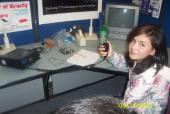
RIGHT: students at Worthington Independent School District #518 in Minnesota take part in an after school enrichment program about Wireless Technology. The students explored magnetic field, Morse code, HF radio signals, GPS, Fox Hunting and how wireless technology has become such an every day occurrence in their lives.
-
Learning about oscillators and antennas
“We started out this year by putting together the oscillators we received. This was a big hit with all the students. Because there was no soldering involved, students of all ages were able to work on the project with immediate success. There was some great problem-solving and experimentation that went on like, “What will happen if I change it so that it has two capacitors instead of one?”. Many went on to add switches and other modifications. Students from other classes saw the project and asked if they could participate too. I have several now studying for their code because of the activity. We have been playing with the information you have us about antennas and beacons. We just completed a Montreal Fox and have been using it to experiment with antennas and signal location. Our students are having great fun with it while learning about the different types of antennas and when to use them, the environmental factors affecting signal strength and direction, how attenuation can help in locating the fox, etc. We spent a couple of days just experimenting with attenuating the signal by using a home-constructed board, by removing the antenna from the HT, by shielding the antenna with our bodies, by using an older radio vs. a newer radio with different shielding, etc. It’s so exciting to see them really thinking and experimenting with the concepts introduced. . . . 1 I have been so pleased with ALL the curriculum materials we received. I was thinking this year I would have to be researching most of the topics to construct lessons for my class. I have been amazed at the amount of information we received and have only had to alter them slightly to fit the needs of my students. Not only has it saved me time, but I feel like I have a wealth of experts who have already done this and are helping guide me through. The institute really helped by giving us material resources (the library has been wonderful!), by letting me see how these resources can be effectively used in classroom instruction (you did a great job modeling it, Mark), and most importantly, by giving me the confidence to teach topics I previously felt unable to teach.” Jill Mohr Oregon City School District Oregon City, Oregon
-
Automated robot control and a weather station
“I found the program to be most informational and rewarding last year. I was able to secure some funding to obtain 3 additional BOE robot kits and 10 Basic Stamp Homework Boards. I have also obtained several of the available sensors as well as the sound board. I have been able to add a section on computer automated control and programming. We have added the weather fax to our classroom weather station as well as expanded our capability to include linking our station to the NWS in Peachtree City (Atlanta) via 2 meters. The students love the opportunity to learn through hand on activity. Although I had attempted to use the basic stamps in the past (by purchasing units with my own funds), the Institute gave me the "ammunition" to show the benefits to students and obtain some funding for the classroom. I even found that I returned to school with a new and energized interest in expanding my course offerings. Thanks for all you do,” Jim Fouts Technology Education Northside High School Warner Robins, GA
-
Learning about electronics with robots
“When school started in August there was a change at central office and the robotics course was now to be an Environmental Science course. I once again leaned on Mark Spencer and the Teacher's Institute and would approach Environmental Science from a robotic rover angle. One reason for the change in course name was due to lack of (or no) funding. The Teacher's Institute course included a Boe-Bot for building and programming. While these robots are low cost it would be too costly for me to supply the school on my own. Not to give up we came up with an alternate idea. The students bring in old model cars, old toys, new low cost models, and in some cases use just a piece of styrofoam. I have some spare electric motors that attach to the "robots" to give them motion. If they need wheels we make some from CD's. In some cases these sentimental vehicles have more value than something store bought. In the closet at school are some breadboards. The students are learning some electronics that were outlined during the Teacher's Institute. The students will attach these breadboards to their "robots" to bring them to life. The next phase is to make the electronics more sophisticated, including radio control. A big draw for these students is learning that you can program IC chips. Many students are into computer games and some have ambitions of become game programmers. It was at the Teacher's Institute that I was exposed to some low cost chip burners (which I purchased). I also teach Physics and I am using the information on lightning and the atmosphere for wave propagation and satellite discussion. While the textbooks offer standard material it is always nice to bring in real life applications to bring knowledge/science to life.” Carl Dombrowik Prince Technical High School Hartford, CT -
Creating a new Satellite Meteorology course
Jim Wingate, WA2EIU, from the Lovett School shares with Mark Spencer, WA8SME, Education and Technology Program Coordinator about a proposed school program based on weather satellite resources:
"The course at our school that you were interested in hearing about is a course that we are offering students next year (I hope students will enroll!) that is called Satellite Meteorology and open to 10th-12th grade students. I did a trail run with an independent study student this past semester and included some of the satellite receiving information that you included in your TI-1 class that I attended a few years ago (Thanks!). We concentrated on various weather satellites and downloaded data on their scheduled passes over Atlanta. The images were processed and appeared on a school web site. (The 3D images were quite a hit with the students.) My wife teaches in our science department (physics) and will team teach this course with me. She has the meteorology background and I will connect the satellites communications to the curriculum material. I have included below the "Catalogue blurb" that we will use to introduce students to this course.
Our school has been able to enhance our science curriculum in a big way by introducing amateur radio (wireless communications as we are calling it here) in our elementary, middle and high school classes over the past few years using many resources that were introduced to me in your TI classes. In a few weeks I will be installing our 3rd amateur radio antenna on the campus for our 3rd radio station. I wonder if I will need to apply for two more club calls? :)
Thanks for all of your educational support over these years and I will look forward to again connecting with the TI program in the future. "
-
Ham Radio at the Rocco Laurie School
"Teacher Carole Perry has proved day in and day out for over 9 years, that this fascinating subject produces interested, excited, happy learners from every segment of our student body."
Read More -
Having a great time with our middle school station!
Oct. 2009 - "I just wanted to drop you a quick email and let you know we are having a great time with our Middle School station. We participated in the School Club Roundup all week during lunch period and a few days after school. We made contacts from California, Texas, New York, Canada, and all points in between. Some of our DX contacts include Croatia, Italy, and Germany.
We learned about Morse code, SSTV, PSK, and listened to a satellite pass. The teachers even offered extra credit to the students who did a report on the places they made contact with.
Thanks again to you Mark, the ARRL, the Teachers Institute and the donors who made this possible."
Bob Fritz N0BOK, School Resource Officer
Worthington Independent School District #518
Worthington, MN
-
LBJ High School Radio Club excels at School Club Roundup
The Club was formed in 2004 as part of ARRL’s ‘Big Project.’ The Club began at the Liberal Arts & Science Academy (LASA), at that time, a program of LBJ High School. In 2007, LASA became its own independent high school. To preserve both our school’s legacy and to promote our Texas roots, the Club chose to keep the K5LBJ call sign and name. Ronny Risinger, KC5EES, an ARRL Teachers Institute graduate, has acted as Sponsor and Trustee of the Club since its formation. Our Elmer for the past seven years is Joe Fisher, K5EJL.
for photos and a video of the club's action in School Club Roundup October 2010.
-
Acres Green Elementary students discuss binary language and carrier waves, initiate new station
Rabbit Ears Club News from September 20, 2011, Meeting. "After introductions, the students discussed the wireless technology and where they use it every day at home and in school. Topics introduced included binary language and RF carrier waves. The students then operated the amateur radio club station making the first ever contacts from Acres Green Elementary thanks to the equipment school grant from the American Radio Relay League. These included 12 various stations in California, Virginia, Mexico, Texas, Arizona, and Ohio."
-
Crossroads School math students program robot microcontrollers
October 2011 - I attended the Parallax session of TI-1 this past summer and enjoyed it very much. We have been
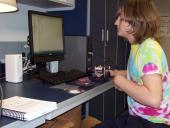 using the robot in one of my math classes lately and it is a BIG hit. It is amazing how quickly students grasp the concept of programming a microcontroller!
 W. M. (“Red”) Willoughby, KC4LE
Mathematics Teacher
Crossroads School
Hoover, Alabama
-
Licensing class offered at Garrett College thru Continuing Education Program
October 2011
Hello Fellow Institute Friends,
I have some good news. I scheduled a Technician license class through Continuing Education at my college. We had 8 people to sign up and 7 passed their Technician exam and one even passed the General exam!!! The really cool thing is a long time ham radio friend of my husband, Art (WA3BOQ), bought a new 2 meter handheld for everyone that passed their test! AND a local ham radio club member paid for everyone's books!! What wonderful Elmers!
We are planning a General class license class that will include building an antenna, a code practice oscillator and learning Morse code. All 8 of the Technician class members are chomping at the bit to sign up. The long range plan is to get the college to sponsor an amateur radio club to tie in with community emergency communications support and the engineering degree.
This is really fun!
Jill Schaumloeffel N2JLC
Garrett College
McHenry, MD
-
Lyman High School Experiences "What's a Microcontroller?"
High School seniors at Lyman High School in Longwood, Florida, led by their teacher, Skip Brooks, WB4YED, had fun during a BOEBOT building and wireless technology focus study recently in their classroom. They even had their BOEBOTs "dancing" together in sync!
-
Physics Students Learn Basic Stamp Programming
May 2012- Using resources from Parallax utilized at the ARRL Teachers Institute, where they were presented to high school teacher, Susan Cundiff, physics students at Gulf Breeze High School in Gulf Breeze Florida learned how to write programs to make their Boe-Bots® perform various functions.
Senior Adam Gunn said, "I learned what it takes to program software and how, all devices use something like what I did in the Basic Stamp Kit." Another senior, Nick Nawaoschik, commented, "It was interesting to learn how electricity works with this kit, and also how a computer can be used along with it."
-
Learning payed forward from the Teacher Institute to the classrom
Summer 2007: The Teacher Institute was very helpful in adding more hands-on experiments and practical consumer electronic information to both Physical Science and Earth Science classes. These are small group classes of six to eight students. Specifically, the software based oscilloscope and robot were big hits. We continue to build simple electronic kits and model rocket payloads (buzzers, blinking LEDs). Since they are easy and cheap to get a hold of, we've given out used CB transceivers going over power supply requirements and homemade antennas.
Brian Olson, N0XFE
Minnetonka High School
Minnetonka, MN
-
One teacher incorporates the element of disaster relief into the classroom
As a conclusion to our final unit this year about Waves, my students were challenged with rescuing the whole school after a mock disaster. We are able to "find" a few raw materials lying around after the disaster incuding a damaged 5 watt 2 meter radio, some empty coke cans, a partial roll of tape and some copper wire. The students had to use the information we talked about in class to fashion an antenna that was effective enough to reach a repeater over 30 miles away with a small radio. The students were extremely excited to be able to use some of my amateur radio equipment in class and were careful to build a very effective antenna which easily hit the repeater in the next county over.
Many teachers have come to me expressing amazement that freshman were that excited about building antennas and using a radio instead of cell phones. Finally, the school's academic coach sent out the following email to the entirety of the school:
"In all, 156 students participated in one way or another during the project (I teach five Physical Science classes in which we did this project). I have many students coming to me asking about if I'm going to start a Ham Club next year and how they can get their Amateur Radio license."
Sharon L. King-Hanley
Academic coach
AVID Site Coordinator
English Dept. Chair
Westside High School, An Early College Academy
-
Teachers Institute enhances teacher instruction
Since attending the basic TI and founding Lampasas Middle School Youth Amateur Radio Club, over 100 students attending LMS have been members of LMSARC. Although, to my knowledge, none of our former members have earned their Amateur Radio license, but have been affected in other ways. One of them will be starting at the University of Texas San Antonio next year to study engineering, having been influenced by his work with the BOE-Bots while enrolled at Lampasas Middle School.
Several years after its start, LMSYARC purchased two more BOE-Bots and has had programming competitions between groups using the various sensors every year since. I would love to expand this and maybe start a robotics competition club separate from LMSYARC. We have also used additional equipment donated by local amateur radio operators to expand our radio experience to include PSK31, 40M, 75/80m and 160m. Five Wouxun HT's were donated by the estate of a local Ham, Rocky Davis, AC510 SK. Four of which are designated to go to the first four youth who earn their Tech tickets.
Gene Case, KU5C
Lampasas Middle School
Lampasas, TX
-
Programming a Robot Demonstrates Real World Applications
October 2013 - Just wanted to share what I have been doing this semester with what I had learned from the TI.
In my C Programming class that I am teaching this Fall, we have progressed to the point where I am showing
 the students how we can move from the computer to the physical world. The students have been designing applications in C to do point of sale, calculate interest, ask for user input to solve various problems, etc...etc.. They have all the basic programming structure down, and we have done a comparison of the syntax of C and PBasic. With the use of the Boe-Bot I am showing the students how we can control things in the physical world with the programs they write. This has added an additional dimension to their thinking of what programming is and what it can do. Before it was just having the computer solve problems, on the screen. Now it is how can I write code to control a device in a real world environment, and react to that environment..This has led to much discussion about industrial robotics, numeric control, and other automated systems, where behind the scenes programmers make it all happen. When I introduced the robot into the programming class, it really boosted the interest and enthusiasm of the students, and next fall I am planning on incorporating even more time with the robot."
Robert Johnson, KC9YTTAdjunct / Computer Information Systems
Carl Sandburg College
Galesburg, IL
-
Students at Glenn Raymond School are analyzing tree data
September 2014 - We do some remote sensing activities in both my 7th and 8th grade science classes. Most of it is introductory cartogrpahy utilizing both traditional compasses and GPS with my 8th graders (I have personal background in cave surveying), and we started utilizing our radio QSO data and correlating frequency and geographic locations. Also plotting and analyizing tree data with my 7th graders.
Troy Simpson, W9KVR
Glenn Raymond School
Watseka, IL