Introduction
Your Amateur Radio station may change, but you have to start somewhere, right?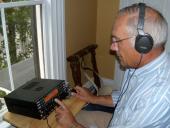
Here are some fundamentals that all Amateur Radio stations have in common:
- Transceiver
- Power Supply
- Antenna System
The Transceiver
Selecting your transceiver will largely depend on how much you want to spend and what you hope to do. If you want to explore long-distance contacts on the HF bands, you’ll need an HF transceiver. If you are interested in chatting with local friends on the VHF or UHF bands, look for a VHF+ FM transceiver.
Build Your Own Radio
Most hams buy their radios factory assembled, but you can design your own transceiver from scratch. There are also many transceiver kits available. Kit building is fun and educational and you’ll save a considerable amount of money in the process. If you think your technical skills are marginal, however, build your kit with the help of a more knowledgeable ham.
HF or VHF Antennas?
Antennas are subjects unto themselves. It all depends on whether you want to get started on the HF or VHF bands. See the sections below and make your choice!
Is QRP Right for You?
QRP enthusiasts operate at only 5 watts output or less. They tend to communicate using CW, but they also use digital modes and occasionally voice. 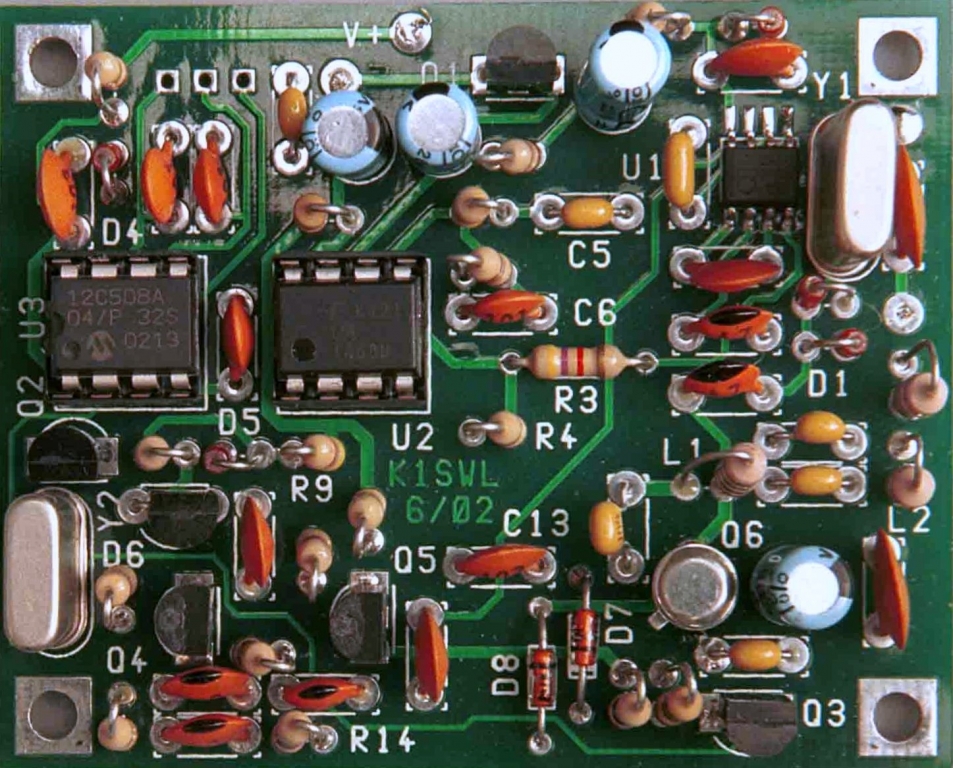 The great advantage of QRP is cost. A QRP transceiver built from a kit can cost less than $200. Low power consumption is another major plus. QRP transceivers can be easily powered from batteries, which make them great for outdoor or emergency operating. The disadvantage of QRP is that you need a very good antenna to make contacts with reasonable ease. This isn’t to say that you can’t make QRP contacts with a poorer antenna (such as a small mobile antenna), but it will be much more difficult. Learn More
Station Power Supply
If you’re considering a handheld transceiver for use on VHF or UHF FM, most of these radios come with their own rechargeable batteries. But if you want to operate the radio without the battery, you may want to invest in a small dc power supply—13.8 volts (V) with a current capacity of about 3 amps (A) will do the job nicely. You can find these at retailers such as RadioShack for about $40 or less.
As you step up to larger radios with more output power, you’ll need larger power supplies to run them. Most of these transceivers do not have their own power supplies, so read their specifications before you buy. A transceiver with a maximum output power of 100 W will require about 25 A of current at 13.8 V when you are operating the radio at “full throttle.” That kind of power supply will cost about $100 to $200.
Don’t worry about buying a power supply with too much current capacity. Your equipment will only draw the current it needs—no more, no less. In fact, it is probably safe to say that you can never have too much current capacity. It may seem economically foolish to invest $200 in a 25-A power supply when all you want to power is a 5-W handheld radio. However, if you think you’ll be upgrading to a larger radio in the near future, you may want to get the big power supply today (especially if you find a great deal on a high-current supply).
When shopping for a power supply, beware of one potential stumbling block. Power supplies are often rated by their continuous and intermittent (ICS) current capacities. The figure you want to look at is the continuous rating—the amount of current the power supply can provide continuously. Don’t be misled by an advertisement that promises a fantastic deal on, say, a 30-A supply. Are those 30 amps provided intermittently—only for short periods of time--or continuously? You need continuous power, so check and be sure!
It is also worth mentioning that you’ll find two types of ham-grade power supplies for sale. The linear design uses a hefty transformer to shift the 120 V ac line voltage from your wall outlet to a lower voltage for later conversion to 13.8 V dc. These power supplies tend to be large and heavy, especially the high-current models.
Another approach to the power supply problem is the switching design. In the switching power supply, the ac line voltage is converted directly to dc and filtered. This high-voltage dc is then fed to a power oscillator that “switches” it on an off at a rate of about 20 to 500 kHz. The result is pulsating dc that can be applied to a transformer for conversation to 13.8 V or whatever is needed. The reason for doing this is that rapidly pulsating dc can be transformed to lower voltages without the need for large transformers. It is the transformer that accounts for most of the weight, size and cost of traditional linear power supplies. A switching power supply is much smaller and lighter, and usually less expensive. If you’re considering a switching power supply, look for models that boast low “RFI” (radio frequency interference). Learn More