ARRL -- The national association for Amateur Radio ARRL -- The national association for Amateur Radio
HamRadioDomains.com -- Ad
Find on this site...
Site Index 
  
Search site:
  
Call sign search:
 
ARRL Member Login...
Username:   Password:

  
Register    Forgot userid/password? 
Quick Links...
Text-only 
ARRL Products:
CD-ROMs

(More)

QST View CD-ROM 1915-2004

The ARRL Emergency Communication Library v. 1.0 -- CD-ROM. Informative documents and presentations on many aspects of emergency communication operating.

NCJ Collection CD-ROM 1973-1998 -- Back issues of NCJ, the National Contest Journal, on a convenient, space-saving CD-ROM.

The ARRL Digital Technology for Emergency Communications Course -- Coming in November! -- CD-ROM. Learn all the ways to use digital technology as an emergency communications tool!

The ARRL Antenna Book -- The ultimate reference for Amateur Radio antennas, transmission lines and propagation. Fully-searchable CD-ROM included. 21st edition.

About Amateur Radio

Where do I start?

Amateur Radio is regulated by the Federal Communications Commission (FCC) under the Communications Act of 1934. It is also subject to numerous international agreements. All Amateur Radio operators must be licensed. In the U.S. there are three license classes. Each successive level of license comes with an expansion of privileges. Your entry into Amateur Radio begins with a Technician Class License.

Earning each license requires passing an examination. Although regulated by the FCC, license exams are given by volunteer groups of Amateur Radio operators. Operating under organizations called Volunteer Examiner Coordinators, volunteers administer and grade tests and report results to the FCC, which then issues the license. U.S. licenses are good for 10 years before renewal, and anyone may hold one except a representative of a foreign government.

What Amateur Radio licenses are available?

Technician Class License. You can get an entry level Amateur Radio Technician license by passing a 35-question multiple-choice examination. No Morse code test is required. The exam covers basic regulations, operating practices, and electronics theory, with a focus on VHF and UHF applications.

Technician Class operators are authorized to use all amateur VHF and UHF frequencies (all frequencies above 50 MHz). Technicians also may operate on the 80, 40, and 15 meter HF bands using Morse code, and on the 10 meter band using Morse code, voice, and digital modes.  No Morse code test is required.

General Class License. The General Class license offers a giant step up in operating privileges. The high-power HF privileges granted to General licensees allow for cross-country and worldwide communication.

Technicians may upgrade to General by passing a 35-question multiple-choice examination. The written exam covers intermediate regulations, operating practices, and electronics theory, with a focus on HF applications. You must successfully pass the Technician exam to be eligible to sit for the General class exam. No Morse code test is required.

In addition to the Technician privileges, General Class operators are authorized to operate on any frequency in the 160, 30, 17, 12, and 10 meter bands. They may also use significant segments of the 80, 40, 20, and 15 meter bands.

Amateur Extra Class License. The HF bands can be awfully crowded, particularly at the top of the solar cycle. Once you earn HF privileges, you may quickly yearn for more room. The Extra Class license is the answer. Extra Class licensees are authorized to operate on all frequencies allocated to the Amateur Service.

General licensees may upgrade to Extra Class by passing a 50-question multiple-choice examination. No Morse code test is required. In addition to some of the more obscure regulations, the test covers specialized operating practices, advanced electronics theory, and radio equipment design.

More detailed information about the privileges of each license class and requirements for licensing can be found at www.arrl.org/arrlvec/license-requirements.html.

How do I prepare for the license exam?

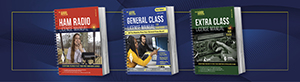
Many publishers, including the ARRL, offer books, courses and computer software to facilitate self-study for the Amateur Radio licenses. In addition, some local Amateur Radio clubs offer licensing classes. Some clubs also provide mentoring support to help new licensees get started.

ARRL study materials are designed to help you understand the context for the licensing exam questions and are a valuable reference even after you get your license. For a description of ARRL licensing study publications visit our store.

ARRL also offers an on-line licensing preparation course for the Technician license. For more information click here

Practice tests and study aids are available from many sources.  Here are a few you may find helpful:

Handihams is a non-profit organization that provides assistance for individuals with disabilities.

For more information on a licensing class near you, go to ARRL’s class search.

Contact a ham radio club near you to find out about classes that may be forming.  Find a club near you through our club search.

To locate an exam session, use our exam session search

What do I need to bring to an exam session?

Exam sessions are conducted by volunteers working under the direction of the FCC.  There will likely be a charge for taking the exam. There is no FCC fee for an initial license, or standard changes to a license. However, there are fees for other FCC services. The exam fee is set by the local exam administrator, the Volunteer Exam Coordinator (VEC), and is usually $14 or less. Contact the exam session administrator to determine the fee that applies to the exam session you plan to attend.

Bring a picture ID (drivers license, passport) OR, when no photo ID is available, two forms of identification must be presented (birth certificate, report card, library card, Social Security card, utility bill, bank statement, etc.).  Students may bring a school ID, and/or a written note from a legal guardian. To be prepared you should also bring two number two pencils with erasers and a pen.  A calculator with the memory erased is allowed.  You may not bring any written notes or calculations into the exam session.

If you have additional questions, call the ARRL’s toll-free line at 1-800-32NEWHAM. You may also request an informational ham radio prospect package.


Page last modified: 04:48 PM, 05 May 2008 ET
Page author: ead@arrl.org
Copyright © 2008, American Radio Relay League, Inc. All Rights Reserved.