Resources for Classroom Teachers
ARRL provides classroom teachers with teaching tools and resources, and connects educators with shared materials.
Teachers who would like to use Amateur Radio as an instructional tool in the classroom find that participation in our Teachers Institute on Wireless Technology provides them with valuable ideas to help design an appropriate plan to engage specific topics of classroom curriculum. It also gives them greater confidence to introduce hands-on activities.
Register with ARRL to receive news about about how other teachers are exploring wireless technology and amateur radio in their classrooms and the latest developments in the Education & Technology Program.
Check out our Forum on Amateur Radio in the Classroom to share ideas and questions about teaching wireless technology topics in the classroom.
Copyright. ARRL ETP resources are intended for educational purposes. When used for this purpose, please acknowledge ARRL as the source. Additional permission is required to use this material in any training or product that will be redistributed or used for re-sale. Learn More
Resource Library
-
The resources provided in this library range from ideas to engage entry level topics in radio science and electronics to hands-on instructional resources to demonstrate topics in radio science to plans for hands-on projects to do amateur radio activities.
-
The Curriculum Guide includes activities that explore wireless technology, career paths, non-verbal communication, Ohm’s law, and building a crystal radio receiver.
Learn More -
Lesson Ideas and Learning Activities
Check out this new library of lessons and activities that are organized around six general topics. You'll find indiciations of the appropriate audience for each lesson or activity, as well as additional references to explore the topic in greater depth. Contribute your lesson ideas!
Learn More -
Find kits and projects to instruct basic electronics, demonstrate wave forms and modulation, conduct a radio direction finding activity, build a seismometer, to name a few.
Learn More -
Explore Satellite Communications
Bring Space into the Classroom. This library is a collection of resources designed for teachers who want to explore satellite communications with students. There are also instructional resources designed for classroom exploration of satellite telemetry data used to understand satellite engineering and research deployed on satellites. The classroom resources are manipulatives that can prepare students to understand and utilize live telemetry data that can be captured live from orbiting satellites.
-
You can download images like these in your classroom. Learn how.
Images courtesy of Matt Severin N8MS.
Learn More -
Our newsletters often include stories and comments from teachers about how they are integrating amateur radio and ETP resources in their classrooms. Their experiences may provide ideas and inspiration for you.
Learn More -
Radio Direction Finding/ Fox Hunting
Radio Direction Finding exercises are a great way to introduce the concepts of antenna directinality, triangulation and principles of interfeence and radio wave propagation.
While teaching at Rock Canyon High School in Douglas County, CO, teacher Cindy Powell, KE0FGH, developed a Fox Hunting exercise and shared the lesson on Orienteering she used to prepare students for the activity.
-
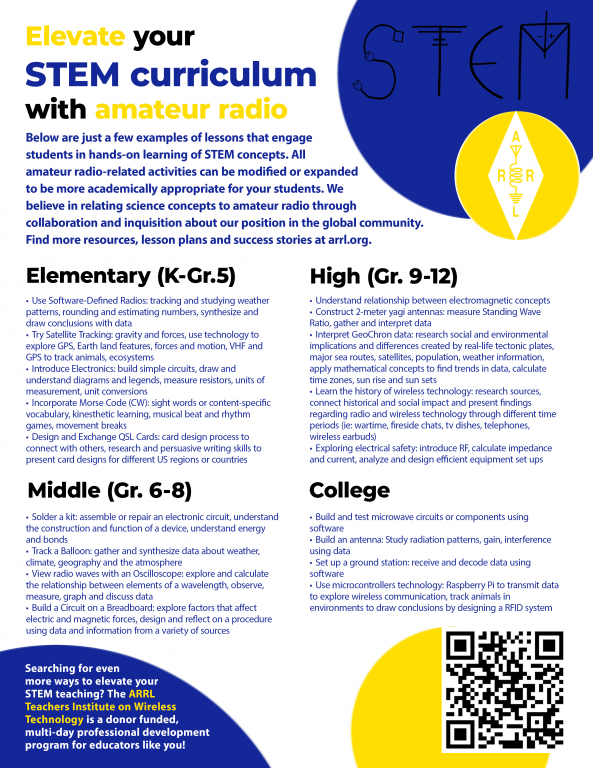
Spread the word about amateur radio's place in the classroom or school club with these info flyers:
Elevate your STEM curriculum with amateur radio
ETP FAQs
-
Select a question below related to using amateur radio in the classroom and making curriculum connections to expand for the answer.
-
If you want to do fox hunting, you can use one class period providing background information on the theory and also a video of biologists using radio direction finding to track and tag animals for study or RD used by search and rescue crews. Then the following period have the kids do a fox hunt with the TX hidden in an animal simulator (teddy bear).
If you want to do some code, there is a simple kit CPO (Code Practice Oscillator: Cheaper Beeper) that the kids can construct (http://www.arrl.org/no-code-cpo-version-1), they can build a simple key, and learn some code. Connect a CPO to a computer running CWGet or similar program and have the kids send code and have it displayed on the computer screen. That has been a successful activity when I used it, which would take a couple of class periods.
If you want to do some space related things, play some audio files of the original Sputnik transmissions as a history lesson; have some tracking software that displays satellite orbits, have a station set up to listen to some ham satellites (voice and telemetry) and/or listen and capture weather satellite imagery. You could try to capture some ISS stuff, but that signal source is not dependable. Have the students construct a model of a cube sat.
If you want to do some ham contacts, use two meters and maybe HF, but if you do this, have “planted” contacts of hams you know who can talk with kids ready to step in and talk if a CQ falls flat. Have the kids make up QSL cards for the contacts, and make sure your “plant” will send a QSL to each student contacted.
-
What do you suggest to teach basic electronics and ham radio to a technology class?
This might be a good place to start.
The Basic Electronics Course is intended for those teachers and instructors that want a ready resource that they can adapt to their instruction of electronic fundamentals. The course is designed around affordable components, prototyping board, and VOM and uses Understanding Basic Electronics as the associated text. This course has components of the old Navy electronics course which is probably the best material I have ever seen. (the Navy apparently has dropped this course, but it is still excellent). The course/ktt including all instructional components and course CD may be purchase directly from ARRL. Schools can apply for a kit (one) that includes the course material on CD- ROM and one set of materials used during the course (text, VOM, proto board, components). Schools should send their request on school letterhead to: ARRL Education & Technology Program, 225 Main St. Newington, CT 06111.
To do more instruction for ham radio licensure, I would recommend you take a look at ARRL's Tech and General license manuals. There is also an instructor’s guide available for the Technician level. The instructor’s guide has a scope and sequence and lesson plans that you can adapt.
In addition to the Basic Electonics Course mentioned above, on the the resource page, www.arrl.org/etp-kits-projects you will find additional hands-on resources for demonstrating the basic principles of radio, in particular the modulation/demodulation board and the 5-building blocks boards.
-
What do you recommend for teaching Amateur Radio and EchoLink?*
A good place to start is to review the Radio Lab Handbook and the Curriculum guide. These materials could serve as a basic text book and give you some lesson ideas to help your student along. www.arrl.org/radio-lab-handbook
A good book that is more advanced than the Lab Handbook would be Understanding Basic Electronics (an ARRL publication). That text along with the Basic Electronics Course could serve as a good course in basic electronics.
For licensing, look at the Ham Radio Licensing Manual (an ARRL publication), this text includes all the background material and the question pool that is required to obtain the Technician Class license. There is also and Instructor's Guide that includes lesson plans and power points that can assist you in developing a ham radio class for your students.
You may want to also consider getting connected with a local ham radio club in yourarea that offers ham radio licensing classes or mentors who can help once the license is obtained. Here’s an easy way to find a club: http://www.arrl.org/find-a-club
-
Do you have any ideas for a summer camp exploring electronics, radios or satellites?
You might consider the ARRL Foundation Grants as a possible source of funding, but those grants will be seed money at best and one time only. But the grant might give you a chance to try something new.
ARRL ETP instructor Nathan McCray K9CPO, is going to conduct a space camp at his school this year with a number of space related activities that the students will experience (read more about Nathan’s activities here: http://www.arrl.org/news/view/blast-off ).
ARRL ETP instructor Miguel Enriquez, KD7RPP, has his students researching putting up a CubeSat and has set that as his end goal, he is also working with this students on
a submersible robot project. One program that recently peaked my interest and is in my cue to explore is the Sea Perch http://seaperch.mit.edu/build.php. Once the investment is made in the vehicle, it can be rebuilt and reused in subsequent camps.
Matt Severin, N8MS, has been doing some interesting high altitude ballooning activities with his students and has produced some exciting results.
As far as ham radio activities are concerned, along with the typical HF and VHF
operations you might consider Fox Hunting or APRS tracking of balloon launches.
Space related activities using ham satellite is a good activity but you need to consider that the satellite times are very limited, and the contacts are very rushed and subtle on the FM birds. If you are going to use satellites you will need to supplement the activities with other satellite operations including the weather satellites and receiving and interpreting satellite telemetry. These birds will give you many more receptions opportunities.
The ISS is a nice touch, but signals from the ISS are unreliable and I would not depend on them being there when you need them…but when they are there, the ISS can be a show stopper. Also related to space activity would be some GeoCashing, if you bring in a discussion on how GPS works.
You can also explore a radio telescope to demonstrate the fundamentals or radio astronomy that might be a project of interest.
-
How can I teach waves in the classroom?
First, we would encourage you to consider attending one of the Teachers Institutes next summer. We cover a lot of useful material that you can integrate into your science classes.
http://www.arrl.org/teachers-institute-on-wireless-technology
Second, you might want to review the curriculum resources and some of the instructional kit resources that are available at this web location: http://www.arrl.org/etp-classroom-resources
Third, on instructing waves. Try dropping a rare earth magnet through three different pipes;, copper, aluminum, and PVC, to demonstrate the two fundamental principles of electronics and electromagnetic waves (1. moving electrons create magnetic fields, 2. changing or moving magnetic fields cause electrons to move). This demonstration is very powerful and is referred back to during the discussion of waves (and basic electronics).
http://www.arrl.org/instructional-demonstrations
Then using an oscillator as a signal source and an oscilloscope to display the waveform on a projection screen, try using the wave to discuss wave vocabulary and the relationship between amplitude and volume or strength, and wavelength and period,
and the independence of wavelength and frequency. The lessons surrounding the modulation board in the references above cover these topics.
Then try using an audio frequency generator and boom box (audio amplifier) with the oscilloscope to demonstrate the physiological effects of sound, particularly high frequency sounds.
Then cover the topic that waves are used to transport energy (or intelligence which is a form of energy) from one location to another. This opens up the world of radio and wireless technology. There are a lot of these topics covered in the references above and this topic is about half of the material covered during the teachers institute. Good luck.
-
How can I use the oscilloscope to reinforce math concepts?
-
What can I do with Amateur Radio in the classroom?
I'd get them started with weather satellites which would also bring other teachers into see what was going on in your classroom. Have you attended one of our Teacher Institutes (TI)? If not, check the ARRL website and register early. You will learn how to incorporate amateur radio into your current curriculum; www.arrl.org/teachers- institute-on-wireless-technology
-
Where can I get more information about connecting a student with Public Service?
There are a lot of school programs out there that connect basic law enforcement curriculum to high schools, particularly at the community college level. One of the problems that this student will face in this regard is his age. LEAs (Law Enforcement Agencies) are hesitant to work with students under the age of 18 because of liability concerns.
One area that this student might want to explore is the ARRL EMCOM course; this course covers the area of emergency communications in support of public service. This is an attractive course because the use of ham radio to support EMCOM allows the participants to actively learn about emergency service and management in a hands-on way without having the complication of age restrictions.
Communications is a critical component of any public service effort and the communicators need to have an understanding of all facets of the public service effort. Students who participate in this kind of program come away from the experience with a better understanding of what is involved with emergency management careers (police, fire, medics, sheriffs, government) so that when it is time to make career decisions, they are in a better position to make career choices.
In the process, they have an opportunity to make real and substantive contributions to the emergency preparedness of their communities (evacuation plans, communications plans for underserved populations, hospital emergency communications plans, school emergency response plans, emergency preparedness training for citizens, etc.). Additionally, there are a lot of excellent on-line FEMA courses that the student can use to study this area.
For more information regarding the ARRL EMCOM course; http://www.arrl.org/public- service
-
How do you teach Amateur Radio to 3rd- 5th grade students to get them licensed?
From TI Instructor, Nathan McCray, K9CPO: I am a fellow educator and I have been very successful in licensing students at that grade level. I have licensed a few dozen students over the past 10 years. My approach is pretty simple. I do the following:
1. I use the instructor guide for whatever license we are pursuing 2. I put together a PowerPoint for each lesson (I teach one lesson per week) that brings some of the material down to their level (See attachment on Antennas and Feedlines).
Note, I tweak my lessons based on the knowledge level of my students. It is very different from year to year so personalizing the lesson is very important.
3. The students read a section of the technician book each week and they are encouraged to take practice tests and to study all week long. I ask them to give me at least 30 minutes a day outside of school to do this.
4. I give them a quiz on things I cover that day and for previous material covered
5. Whenever I am teaching I use a ton of hands on activities
6. When they start getting 90% of the practice tests correct I schedule a test with our local VE's.
7. I have learned not to underestimate how much the students can learn!
8. I stay positive all the time!!!
-
What are the real life applications to a binary search?
Absolutely everything these days depends in some way on ADC, which depends totally on binary searches. I can’t stress enough how important ADC and binary searchers are to our existence today. So the answer to your question, binary search is as important as air and cheeseburgers are to our lives.
When your school secretary accesses the records data base to look up a student’s home phone number, they are using binary searches.
When the students push a button on the soda machine at the corner store to select the flavor they want, they are using binary searches.
When the students turn on the i-pod to listen to music or to make a phone call, they are using thousands upon thousands of binary searches every second.
When the student’s parents press the button and the key fob to unlock the car door, they are using binary searches.
I guess the problem is that ADC and binary searches are so common and so important that it is difficult to give that one “ah-ha” example that illustrates their importance. It is sort of like communications (the exchange of ideas between humans). It is very difficult to describe and explain communications (I have a Master's degree in the subject and I still struggle with the concept), because it is so fundamental to human existence, everyone does it 24/7 their whole lives, that we don’t think about it much. That is what binary searches are for us today.
So, I never answered your question. A kid drags their finger across their i-phone screen to access some application, that is an example of a binary search. So I guess the question shouldn’t be “what is a binary search?”, the question should be “what isn’t a binary search?”
The question remains unanswered
-
What type of antenna makes the most sense for a school station?
Antenna selection and installation is about the hardest part of the school station to come up with; too many variables and too many restrictions. So each installation is unique and it would be impossible to give you a "one size fits all" recommendation. Additionally there are personal preferences based on experiences. Some hams swear by a particular antenna that is a "must" and others would recommend something totally different. So my recommendation on the Hustler antennas must be considered through those filters and from my experiences of installing antennas at school sites personally and from what I have seen over the years as others try to set up stations in schools.
The first few things to remember is that any departure in size from the basic dipole will generally degrade the performance of an antenna...it is just physics. Most times reducing the size of an antenna is a necessary tradeoff that must be taken to get something in the air, so you have to accept the reduced performance. In the majority of cases the reduced size antennas will work satisfactorily and give your students a great ham radio experience. The other thing to try to remember, particularly in a school environment, is to keep the installation simple. You are generally not going to have unfettered access to the antenna at the school site to tweak the antenna or make repairs and adjustments. You also have to consider if the school will require that the antenna be installed by a professional or if the local hams will be allowed to do it. This makes a huge difference in the type of antenna you want to install. When I was in the classroom, I had a principal/superintendent who let me do anything I needed to do to install the antenna on the roof...until the school was getting the new roof, then he was a little more restrictive. When I was the school principal, I did what I wanted because the distances involved with the district office basically made me the on-site superintendent.
Okay, now on to the specifics. In my experience, the Hygain antennas are relatively delicate and complicated to assemble, meaning they take frequent maintenance in high wind or high humidity/salt air environments. The attached radial system are shortened radials. The shortened radials are a far departure from the 1/4 wavelength radials that are most efficient to simulate the ground at the elevated location.
On the Hustler trapped verticals (6BTV I think would give you 10-80, but not the WARC bands), it is a very rugged antenna and simple use of traps. It can be ground mounted without radials but it is rare that the ground conductivity is good enough for optimum antenna performance without even ground radials buried a few inches below the grass surface. I doubt that a ground mounted vertical would be acceptable at a school location. If the Hustlers are elevated, (and all verticals are this way) you have to attach at least 2-1/4 wave length radials for each band you want to use. The radials have to fan out around the base of the antenna. You could do this on a flat roof of a school, just have the radials lay on the roof surface with some sort of weight at the radial ends to keep them in place (small sand bags will work). I had good results with an alternative radial scheme that is detailed by DX Engineering for their radial kit. Their scheme is to put as many 20 foot radials around the base of the antenna as you can make, like a radial curtain around the bottom laying on the roof. This works very well, but it does require retuning the traps of the antenna (not a big deal, unscrew a clamp, move the parts, check with an SWR meter, tighten the screws). I use 20-20 foot radials on a ground mounted Hustler. I don't break pile-ups with the antenna, but when I make the kinds of contacts that I like to make (casual), I get acceptable reports...not 45 dB over 9, but S 7-9 at least...good enough to be reliably heard.
You also need to realistically look at the type of operating you expect to do. Many teachers get over enthusiastic thinking that they are going to use all the bands and chase all the DX with their students and they want a first rate antenna installation for a DX power house. Nice, but in virtually every case, the school operation settles down to the basics, some 40 and 20 meter SSB casual contacts when the propagation gods get everything aligned, skip, bell schedules, time zone alignments etc. Because the WARC bands are not harmonics of the traditional bands (80-10 meters), antennas that cover the traditional bands and the WARC bands in one antenna tend to be very complicated, delicate, and expensive. You will have to determine if you really will use the WARC bands.
So I really didn't answer your question, because I can't. It all comes down to what you want to do, and what your school will allow you to do, and what physical limitations you face at the specific school site. All I can recommend is that if you go to your local ham expert with all sorts of technical and operating experience for advice, take that advice and temper it with the realities you face as a classroom teacher in a restrictive school environment. Yes we would all like to have 150 foot towers with large beams and long wire dipoles being fed by 2KW linears, to maybe bust a pile-up to hear the DX operator say "you're 59 say again call sign?", but in most cases, simple 40/20 meter SSB stations will be about the most effective school station that supports your curriculum. One case in point; a school just had to have a Stepper IR vertical antenna for 20 meters and above, with a solid state linear amplifier because the 1st grade students were going to "talk to the world" and gain all sorts of cultural experiences...and this is the absolute minimum station required to do the job...according to the local ham elmer. The antenna cost over $600, we did not support the linear, the local club ended up ponying up the $6,000 to buy the linear. When I visited the school a year later, the antenna was still in the box, the linear had been used only one time because of all the interference it caused with the school IT network, and they had a home brew, single band (I think it was 20 meters) vertical pole for the antenna.
Virtually all of the schools operating with the 1st grade students was with an HT using the local repeaters.
When I recommend tempering the advice, that includes the advice I give you here!
-
Teachers Institute
Training on how to teach radio science as part of classroom curriculum. Learn More

-
ETP Grants
ARRL offers grants for radio stations and other equipment to bring amateur radio into classrooms. Learn More

Licensing, Education & Training >> Amateur Radio in the Classroom >> ETP Classroom Resources